

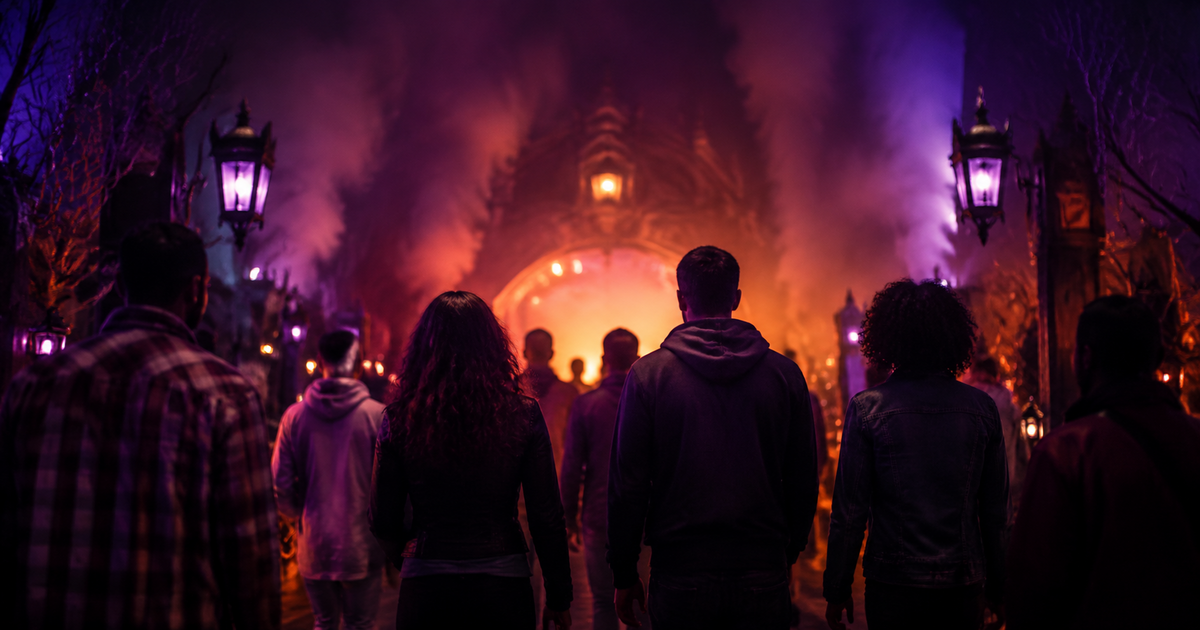
Haunted House with Friends: The Ultimate Group Night Out Guide
Going to a haunted house with a group is the most popular way to experience professional scares — and the right preparation makes it dramatically better. Key tips include discussing everyone’s comfort level before you go, understanding how your group’s positioning in line affects individual scare intensity, and checking the attraction’s group size policies in advance. Groups of 4 to 8 tend to have the best experience, balancing scare exposure with the reassurance of numbers.
A haunted house alone is terrifying. A haunted house with your closest friends is an entirely different kind of experience — equal parts thrilling, hilarious, and something you will talk about for years. But a poorly planned group haunted house night can also be a logistical mess, a source of interpersonal tension, and a disappointment for everyone involved. Getting the group dynamics right is half the experience.
This guide covers everything from choosing the right attraction for your group’s comfort level to the tactical details of who should walk in front — because where you stand in line matters more than you think.
Why Groups Make Haunted Houses Better (and Sometimes Worse)
The social dimension of a haunted house visit is where most of the memorable moments come from. The shared screams, the involuntary grabs of whoever is nearest, the post-haunt debrief over food — these are experiences that require other people to fully exist. Research on fear experiences consistently shows that shared fear deepens social bonds and creates stronger emotional memories than solitary frightening experiences.
But groups can also become their own source of dysfunction. One person’s determination to prove they aren’t scared by cracking jokes at every actor can deflate the atmosphere for the entire group. Someone who is genuinely overwhelmed and refuses to say so can turn the experience stressful for whoever is accompanying them. And groups that haven’t discussed comfort levels or scare intensity beforehand sometimes find themselves at an attraction that is far outside what part of the group signed up for.
The fix is simple: a brief group conversation before you go. Not a lengthy negotiation — just a five-minute check-in about intensity expectations, what kind of haunted house you’re going to, and how you’ll handle it if someone wants to leave early.
How Many People Should Be in Your Group?
Most professional haunted houses are optimized for groups of 2 to 8 people. This range is where the experience design works best: you’re close enough to feel the social energy of shared scares, but small enough that actors can target and interact with your group meaningfully rather than managing a mob.
Groups larger than 10 or 12 begin to create challenges. Many haunted houses will split large groups into smaller units anyway to maintain queue flow. A group of 15 may enter as three separate groups of five, which removes much of the social cohesion benefit. If your group is large, contact the attraction in advance to ask about their group size policy and whether they offer group booking options that allow you to go through together.
Very small groups — just 2 people — work well but expose you more directly to actor interaction with no one to hide behind. Two-person groups should expect to be the focus of every scare with no buffer. For some people that’s exactly what they want; for others it may be more intense than anticipated.
Having the Pre-Haunt Fear Talk
Before you go, take five minutes as a group to discuss three things. First, the intensity level: make sure everyone knows what kind of haunted house you’re going to. A family-friendly Halloween walk-through and an extreme contact haunted house are completely different experiences, and showing up to the wrong one creates problems. Second, comfort limits: does anyone have specific triggers — clowns, spiders, claustrophobic spaces, strobe lights — that they want the group to know about? Third, the exit plan: agree in advance that if anyone wants to leave, the group leaves together, or that a designated companion will escort anyone who wants out while the rest continue. No pressure, no judgment — agreeing to this in advance removes the embarrassment of needing to use it.
Group Positioning: Who Goes First, Who Goes in the Middle?
This is the most underappreciated tactical element of a group haunted house visit. Where you stand in the group significantly affects how intense your individual experience is.
- Front of the group: The highest-intensity position. Actors pop out at you first, you encounter every scare before the group behind you has processed it, and you have no one ahead to deflect attention. Go first if you want maximum scares and are comfortable leading the group through darkness.
- Middle of the group: The most protected position. You have both a buffer ahead of you and companions behind you. This is the right position for anxious visitors or anyone who wants to experience the scares without being the primary target.
- Back of the group: The second-most intense position after the front. Actors who have already engaged the front of your group often follow the group from behind, re-engaging as they trail the group. The back position gets haunted from the rear rather than head-on.
Decide positioning based on each group member’s stated preference — let the people who want maximum scares take the front and back, and give the more anxious members the middle positions. This simple arrangement significantly improves everyone’s experience.
Booking and Logistics for Groups
Professional haunted houses handle groups differently depending on their policy. Many require all group members to arrive together before the group can enter as a unit — if three people are late, the other seven may need to wait at the entrance rather than starting and meeting them inside. Confirm arrival logistics in advance. For large groups, buying tickets together online is usually more efficient than having everyone purchase individually at the gate, and some haunted houses offer group discount rates for parties above a certain size — always worth asking.
Parking and transportation logistics for larger groups deserve advance thought. A haunted house with limited parking can create a frustrating pre-experience for a group of 12 arriving separately. Consider carpooling or rideshare coordination to ensure everyone arrives at the same time without a parking scramble.
The Night-Out Framework: Before and After the Haunt
The haunted house is the centerpiece of a great group night out, not the entire event. Structuring the evening with dinner or drinks before and a social debrief afterward is how a haunted house visit becomes a full, memorable experience rather than a 45-minute activity with an awkward ending. Dinner before the haunt gives the group time to build social energy and discuss expectations. Post-haunt food or drinks gives everyone a venue to debrief the experience — the shared narrative of who screamed first, what the best scare was, and who pretended not to be scared but clearly was — and those conversations are where the lasting memories form.
If Someone Gets Too Scared: How to Handle It Well
It happens, even to people who expected to be fine. If a group member becomes genuinely overwhelmed inside a haunted house, the best response is calm and immediate: alert the nearest actor or staff member that you need assistance exiting, and have a designated group member stay with the overwhelmed person while the exit is arranged. Professional haunted houses always have exit pathways and staff trained to assist guests who need to leave calmly. Avoid making the moment a significant event — treat the exit as completely unremarkable, get everyone outside, debrief briefly, and decide together whether the rest of the group wants to continue or call the night.
Big groups especially should brush up on haunted house etiquette before going in.
Frequently Asked Questions: Going to a Haunted House with a Group
How many people should be in a haunted house group?
The optimal group size for haunted houses is 4 to 8 people. This range allows strong social energy and shared scare experiences while remaining small enough for actors to interact meaningfully with your group. Groups larger than 10 may be split into smaller units by the attraction’s queue management.
Should I go first or in the middle of the group in a haunted house?
Go first if you want maximum scare exposure — actors target the front of the group first. Go in the middle for the most protected experience. The back position is second-most intense since actors often follow groups from behind. Decide positioning based on each group member’s stated preference before entering.
Do haunted houses offer group discounts?
Many professional haunted houses offer group discount rates for parties above a minimum size, often 10 to 15 people. Always contact the attraction in advance to ask about group pricing, combined ticketing options, and policies for large groups moving through the attraction together.
What should I do if someone in my group gets too scared?
Alert the nearest actor or staff member immediately and request assistance exiting. Professional haunted houses always have exit routes and trained staff who can escort guests out calmly. Treat the exit as completely unremarkable so the person doesn’t feel singled out, then debrief together outside.
What is the best haunted house night-out plan?
Structure your evening with dinner or drinks before the haunt to build social energy, then head to the haunted house as a group, and plan a post-haunt food or drinks stop for the debrief. The pre- and post-haunt social time is where many of the best group memory moments actually happen.
Find the perfect haunted house for your group night out at the HauntHarvester Haunted House Directory — search by state, scare level, and features to find the right fit for your crew.
As an Amazon Associate we may earn commission from qualifying purchases at no extra cost to you.
new in halloween animatronics
Our honest Spirit Halloween Mr. Dark review: a black-robed skeleton that pops up to nearly nine feet on a scissor lift for $370.99. We score it 3.9 of 5.
Our honest Spirit Halloween Electrified Corpse review: a wire-wrapped torso that violently shakes and screams overhead for $149.99. We score it 3.4 of 5.
Our honest Spirit Halloween Wind-Up Wally review: a creepy wind-up clown with a 360-degree spinning key and a pop-up scare for $185.99. We score it 3.5 of 5.
Find Haunted Houses in:
trending in haunt industry
Everything you need to know about East Coast Haunters Convention 2026 — dates, location, what to expect, haunt tours, seminars, and how to get tickets before prices increase.
HalloweenCostumes.com's 2026 Fan Design Program lets you design a real Halloween animatronic. Two winners get 10 props each plus 5% revenue. Submissions close April 30.
ShudderCon 2026 runs April 25–26 at Camp Jordan Arena in East Ridge, TN. Tickets from $15–$75. Here's the full preview for horror fans, haunt pros, and scare actors.