

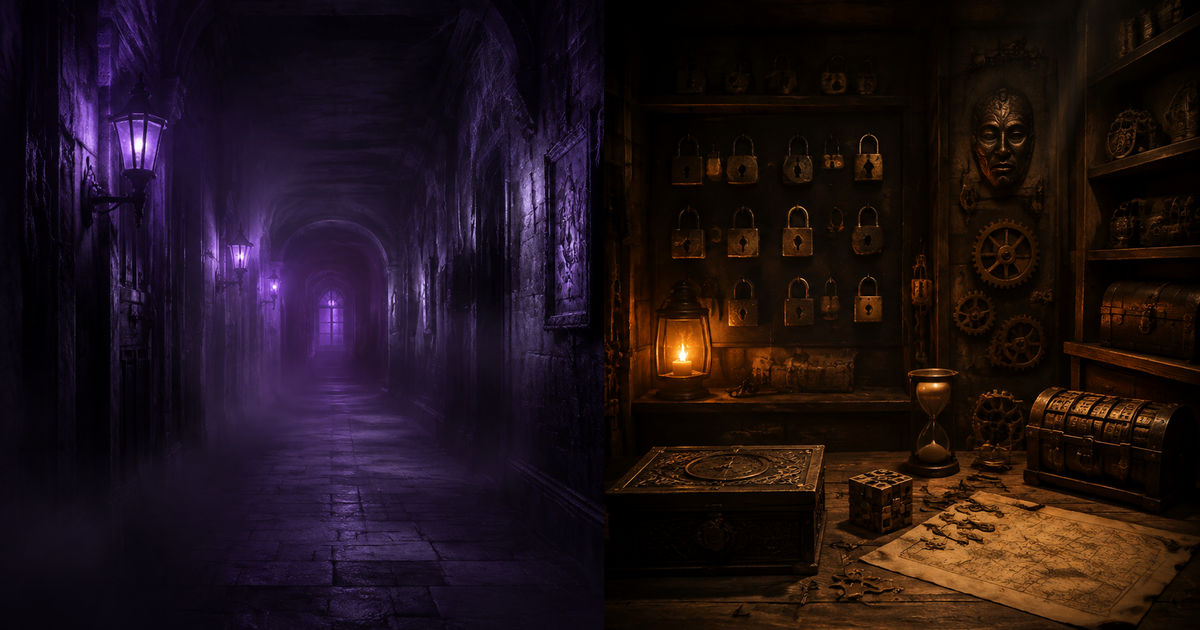
Haunted House vs Escape Room: Which Delivers the Better Scare?
Haunted houses and escape rooms both deliver fear, but in fundamentally different ways. Haunted houses are passive, theatrical experiences driven by jump scares, atmosphere, and actor performance; escape rooms are active, puzzle-driven challenges where you must solve your way out. Which is better depends on whether you prefer being scared as a spectator or being terrified as a participant.
The question comes up every October: do you book tickets to the haunted house down the road, or try the horror-themed escape room that just opened nearby? On the surface, both promise to scare you. But the mechanics, the social experience, the type of fear produced, and the overall value proposition are meaningfully different. Here’s a complete, honest comparison to help you choose.
The Core Difference: Passive vs Active Fear
This is the fundamental split between the two formats. A haunted house is a passive experience — you walk a pre-designed path, actors and effects attempt to scare you, and your job is simply to keep moving. The environment does the work. You are the audience.
An escape room is an active experience — you and your group must solve puzzles, find clues, and work toward an objective. Horror-themed escape rooms layer that puzzle mechanic with actor interaction, jump scares, and atmosphere, but the core structure requires participation. You are the protagonist.
Neither format is superior — the passive/active split is a preference question. People who want to be scared without responsibility (no pressure to perform, no failure state) tend to prefer haunted houses. People who want fear with stakes and cognitive engagement tend to prefer escape rooms.
Type of Fear: Jump Scares vs Sustained Tension
Haunted houses are optimized for acute fear — startle responses, jump scares, sensory overload, and physical startle. A well-designed haunted attraction cycles between moments of atmospheric dread and sudden performer appearances. The fear is intense but episodic. Once a scare happens, you recover quickly and move on to the next one.
Horror escape rooms produce a different emotional register: sustained psychological tension. The ticking clock, the pressure of unsolved puzzles, the uncertainty of what happens if you fail — these create a low-grade anxiety that doesn’t release until the room is solved or time expires. Actor interactions in escape rooms feel more personal because they respond to your behavior rather than following a scripted beat.
If you’re trying to terrify a friend who is easily startled, a haunted house is the more reliable delivery mechanism. If you want a group to experience shared dread and collective problem-solving under pressure, a horror escape room is the better choice.
Group Experience and Social Dynamics
Both formats work in groups, but they create different social dynamics.
In a haunted house, group reactions are additive — screaming together, grabbing each other’s arms, laughing at each other’s reactions — but the group doesn’t actually collaborate. You can walk through a haunted house alone and have the same experience as in a group of ten, minus the social entertainment of watching your friends get scared.
Escape rooms are built for collaboration. Larger groups typically divide and conquer puzzle tracks, communicate findings, and rely on each other’s strengths. Horror escape rooms create memorable shared experiences because the group succeeds or fails together, and the pressure of the objective binds the group in a way that passive haunted house attendance doesn’t.
For team-building contexts, first dates, or groups where interpersonal chemistry is the goal, escape rooms are the stronger choice. For groups that simply want to be scared together in the most direct sense, haunted houses deliver.
Seasonality and Availability
This is a practical differentiator that often resolves the debate by default.
Haunted houses are overwhelmingly seasonal, operating primarily from late September through early November. A small number of “year-round” haunted attractions exist across the country, but they are the exception. If it’s not October, your haunted house options are limited.
Escape rooms are open year-round, making horror-themed escape rooms the only reliable way to get a structured scare experience in January, March, or July. If you’re reading this outside of fall, escape rooms are your path to the experience you’re looking for.
Cost Comparison
Haunted houses typically run $20-$40 per person for regional attractions, scaling up to $50-$100+ for premium theme park events like Halloween Horror Nights. Price varies dramatically by market and attraction quality.
Escape rooms typically run $25-$45 per person for standard experiences, with premium immersive rooms running $50-$75 per person in major markets. Pricing is usually per-group-booking with a per-person calculation, meaning smaller groups pay effectively more per person than full-room bookings.
On a per-person basis, costs are comparable. The key difference is time: a haunted house is consumed in 15-45 minutes and may be followed by additional attractions in the same venue, while an escape room occupies a defined 60-90 minute block.
Which Should You Choose?
Choose a haunted house if: you want maximum jump-scare intensity in a short time window, you’re visiting in October with a group of varying preferences, you want to experience professionally produced theatrical horror, or you want to visit multiple scare experiences in a single evening.
Choose a horror escape room if: you want a structured challenge with stakes, you’re visiting outside of October, you want a shared team experience with a defined beginning and end, or you’ve done standard haunted houses and want a more immersive format.
The best option, when possible, is both in the same evening — a horror escape room as the opener (finite, structured, mentally engaging) followed by a haunted house (atmospheric, actor-driven, emotionally cathartic). Together, they cover the full spectrum of what the scare entertainment category can deliver.
Comparing other fall outings? See haunted house vs. corn maze.
Frequently Asked Questions
Are escape rooms scarier than haunted houses?
It depends on what frightens you. Escape rooms create sustained psychological tension through time pressure, puzzle stakes, and actor interaction. Haunted houses deliver intense but brief jump scares and startle responses. Many people find escape rooms more psychologically disturbing; others find haunted house scare actors more viscerally frightening. Most scare enthusiasts recommend trying both.
Can you do a haunted house and escape room the same night?
Yes, and many scare fans prefer this format. Book an escape room as an opener (60-90 minutes, structured), then head to a haunted house for the back half of the evening. This sequence works well because the escape room’s mental engagement shifts to the haunted house’s sensory overload.
Are there escape rooms that are as scary as haunted houses?
Yes. Premium horror escape rooms — particularly those featuring live actors, complete darkness elements, and non-linear horror themes — can match or exceed haunted house fear intensity. Look for escape rooms with “extreme” or “immersive” branding for maximum intensity experiences.
Which is better for a first scare experience?
A haunted house is typically the better entry point for first-timers. The passive format means there’s no performance pressure, no failure state, and no time limit. Escape rooms add cognitive pressure that can overwhelm visitors who are simultaneously managing a new fear context.
Are haunted houses or escape rooms better for groups?
Escape rooms are better for groups that want collaborative, memorable shared experiences. Haunted houses are better for large groups (10+) where coordinating an escape room booking is impractical, or for groups with significant variation in scare comfort levels.
Ready to find the best haunted house near you? Search the HauntHarvester directory and discover top-rated haunted attractions by state, scare level, and date.
As an Amazon Associate we may earn commission from qualifying purchases at no extra cost to you.
new in halloween animatronics
Our honest Spirit Halloween Mr. Dark review: a black-robed skeleton that pops up to nearly nine feet on a scissor lift for $370.99. We score it 3.9 of 5.
Our honest Spirit Halloween Electrified Corpse review: a wire-wrapped torso that violently shakes and screams overhead for $149.99. We score it 3.4 of 5.
Our honest Spirit Halloween Wind-Up Wally review: a creepy wind-up clown with a 360-degree spinning key and a pop-up scare for $185.99. We score it 3.5 of 5.
Find Haunted Houses in:
trending in haunt industry
Everything you need to know about East Coast Haunters Convention 2026 — dates, location, what to expect, haunt tours, seminars, and how to get tickets before prices increase.
HalloweenCostumes.com's 2026 Fan Design Program lets you design a real Halloween animatronic. Two winners get 10 props each plus 5% revenue. Submissions close April 30.
ShudderCon 2026 runs April 25–26 at Camp Jordan Arena in East Ridge, TN. Tickets from $15–$75. Here's the full preview for horror fans, haunt pros, and scare actors.