

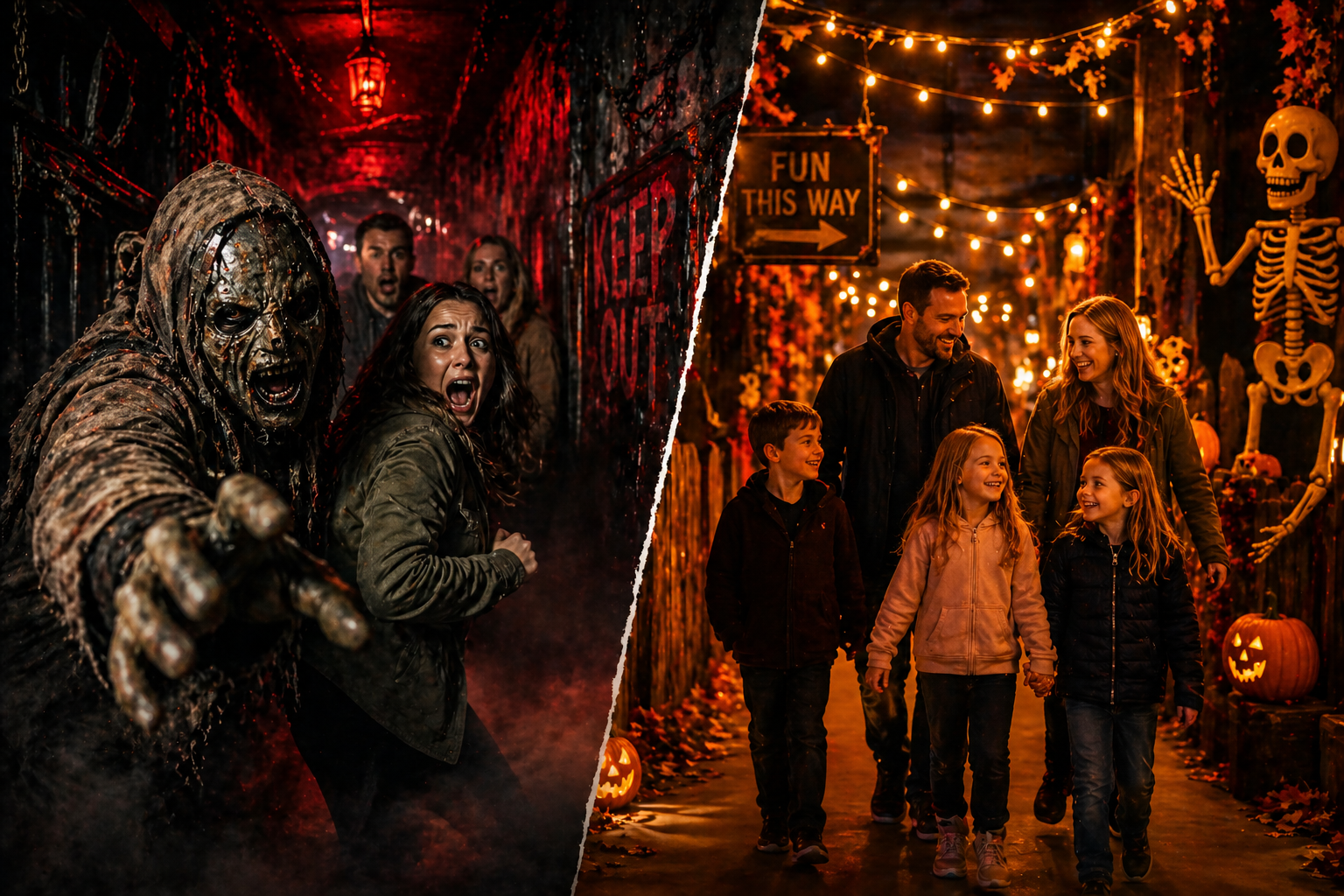
Extreme vs Family-Friendly Haunted Houses: How to Choose the Right One
Extreme haunted houses are professional scare attractions designed for adult thrill-seekers that may include physical contact, total darkness, crawl spaces, disorienting environments, and intensely graphic horror themes. Family-friendly haunted houses are designed for all ages with milder scares, no physical contact, well-lit paths, and age-appropriate themes. Choosing between them depends on your group’s age, scare tolerance, and willingness to be physically and psychologically challenged.
Not all haunted houses are created equal. Walk into the wrong one — either too intense for your group or too mild for your expectations — and you’ll leave disappointed. The haunted attraction industry has evolved into a diverse ecosystem ranging from gentle harvest festivals to full-contact psychological endurance events. This guide helps you navigate the spectrum so you choose the right experience every time.
What Makes a Haunted House Extreme?
The term “extreme haunted house” covers a wide range of experiences, but they share common characteristics that set them apart from standard haunts. At the core, extreme attractions are designed to push guests to and sometimes past their comfort limits. They’re explicitly adult experiences, typically restricted to guests 18 and older.
Common features of extreme haunted houses include:
- Physical contact: Actors may grab, restrain, drag, or touch guests as part of the experience. This is always disclosed in advance and requires explicit consent.
- Total darkness: Portions of the attraction are completely dark, requiring guests to navigate by touch, sound, or a provided light source.
- Crawl spaces and confined areas: Guests may need to crawl through tunnels, squeeze through tight passages, or navigate sensory deprivation environments.
- Graphic horror content: Realistic gore, disturbing psychological themes, explicit scenarios, and intense audio-visual stimulation.
- Extended duration: Some extreme haunt experiences last hours rather than minutes. Events like McKamey Manor or Blackout Haunted House are more akin to endurance challenges than traditional attractions.
- Waiver requirements: Most extreme haunts require guests to sign a detailed liability waiver acknowledging the nature of the experience.
Well-known extreme haunted houses include Blackout (Los Angeles/New York), Heretic (Atlanta), 13th Gate (Baton Rouge), The Darkness (St. Louis), and various regional premier-level attractions. These venues invest heavily in production quality and actor training to deliver genuinely unsettling experiences.
What Is a Family-Friendly Haunted House?
Family-friendly haunted houses are designed to be fun and spooky without crossing into genuinely frightening or inappropriate territory. They’re crafted for guests of varying ages — typically children 5 and up — and feature clearly defined scare levels that stay in the “fun” zone rather than the “genuinely disturbing” zone.
Family-friendly haunts typically feature:
- No physical contact policy: Actors are strictly prohibited from touching guests.
- Adequate lighting: Paths are visible, and the environment doesn’t rely on total darkness to disorient visitors.
- Age-appropriate themes: Think classic Halloween imagery — witches, skeletons, jack-o-lanterns, friendly ghosts — rather than gore, extreme violence, or psychological horror.
- Calm zones: Many family venues include “no-scare” pathways or zones where parents can guide young children through without any actor interaction.
- Shorter experiences: Family haunts are typically 10 to 20 minutes, keeping engagement without overwhelming young visitors.
Scare Level Breakdown
Most haunted attractions self-rate on a scare scale, though standards vary. HauntHarvester recommends evaluating attractions on three dimensions: Intensity (1–5) measures how aggressive and in-your-face the actors are; Theme Darkness (1–5) rates how graphic or disturbing the content is; and Physical Challenge (1–5) covers crawl spaces, physical obstacles, or total darkness. A family-friendly haunt scores 1–2 across all three. A mainstream professional haunt scores 3–4. True extreme haunts push into 4–5 territory across all dimensions simultaneously.
Age and Audience Fit
Age guidance from operators is your best first filter. Most serious haunted houses recommend 12 and older at minimum, with 16+ being common for high-intensity attractions. Extreme haunts are nearly universally 18+ and enforce this with ID checks.
For groups with mixed ages, look for venues that clearly explain their fear level upfront. The best operators publish scare ratings, content warnings, and physical requirement disclosures on their websites, making it easy to match the experience to your group.
Physical Contact and Consent
This is the clearest dividing line between standard haunts and extreme experiences. In a standard professional haunted house, actors are trained to perform near you — they may lean in, scream in your face, follow you, or get uncomfortably close — but physical contact is explicitly prohibited. In family-friendly haunts, actors maintain even more distance to avoid any chance of a child being touched unexpectedly.
In extreme haunted houses that permit physical contact, consent is always a precondition. Guests are briefed before entry, sign waivers, and are given a safe word that immediately stops the interaction when used. Reputable extreme haunt operators take consent protocols seriously and train their actors rigorously.
Ticket Price Differences
Family-friendly haunted houses are typically priced lower — $10 to $20 per person — reflecting their shorter duration and community-run nature. Standard professional haunted houses run $20 to $45 at most venues. Extreme haunts often command $40 to $75 or more, reflecting their higher production values, smaller group sizes, longer durations, and specialized actor training requirements. Some venues offer tiered experiences on the same property — family haunt, standard haunt, and extreme option — at three different price points.
How to Evaluate a Haunted House Before You Go
Before booking any haunted attraction, spend 10 minutes on research. Check the venue’s website for posted scare ratings, content warnings, age recommendations, and physical requirements. Read recent reviews on Google Maps, Yelp, or TheScareFactor.com for firsthand accounts of the actual intensity. Look for the venue’s policy on physical contact, safe words, and exit options. When in doubt, call the venue directly — a well-run haunted attraction will happily help you understand whether their experience is right for your group.
Frequently Asked Questions
What is the scariest type of haunted house?
Full-contact extreme haunted houses that combine physical interaction, total darkness, extended duration, and graphic psychological horror content are widely considered the scariest. Events like Blackout Haunted House and some regional invitation-only extreme haunt events represent the top of the intensity spectrum.
Are family-friendly haunted houses actually scary?
For young children and first-timers, absolutely. Family-friendly haunts are designed to be appropriately spooky — enough to thrill younger visitors without traumatizing them. Adults who regularly visit professional haunted houses will likely find family haunts mild, but that’s by design.
Can a 10-year-old go to a haunted house?
It depends on the child’s individual tolerance and the specific attraction. Many family-friendly haunted houses welcome children 5 and up with parental guidance. Standard professional haunted houses often recommend 12+ as a minimum. Always check the venue’s stated age guidance and know your child’s sensitivity to startling content before purchasing tickets.
Do extreme haunted houses actually hurt people?
Reputable extreme haunted houses have detailed safety protocols, trained actors, and clear consent and safe-word systems. Injuries are rare when proper protocols are followed. That said, extreme haunts are not appropriate for everyone — people with heart conditions, anxiety disorders, claustrophobia, or low pain tolerance should choose standard or family-friendly experiences instead.
What is a safe word at a haunted house?
A safe word is a specific phrase — often ‘mercy,’ ‘safety,’ or ‘I quit’ — that guests can say at any point during an extreme haunt to immediately stop the experience. All legitimate extreme haunt operators brief guests on the safe word before entry and train actors to respond to it instantly and without judgment.
Not sure which scare level is right for you? Browse the Haunt Harvester Directory — every listing includes fear ratings, age recommendations, and detailed attraction descriptions so you can find the perfect haunted house for your group, from family-friendly to terrifyingly extreme.
new in halloween animatronics
Our honest Spirit Halloween 5 Ft 8 In Valak (The Nun) animatronic review: a $325.99 officially licensed lunging demon nun scored 4.0 out of 5 for scare.
Our honest Spirit Halloween LED Red and Black Jumping Spider review: a $49.99 motion-activated jump prop with light-up eyes, scored 3.3 out of 5 on value.
Home Depot's 12 ft Skelly sells out fast every year. See when it restocks in 2026, the $299 price, and how to buy the giant skeleton before it is gone.

Paid link: As an Amazon Associate we may earn commission from qualifying purchases at no extra cost to you.
Find Haunted Houses in:
trending in haunt industry
Everything you need to know about East Coast Haunters Convention 2026 — dates, location, what to expect, haunt tours, seminars, and how to get tickets before prices increase.
HalloweenCostumes.com's 2026 Fan Design Program lets you design a real Halloween animatronic. Two winners get 10 props each plus 5% revenue. Submissions close April 30.
ShudderCon 2026 runs April 25–26 at Camp Jordan Arena in East Ridge, TN. Tickets from $15–$75. Here's the full preview for horror fans, haunt pros, and scare actors.