

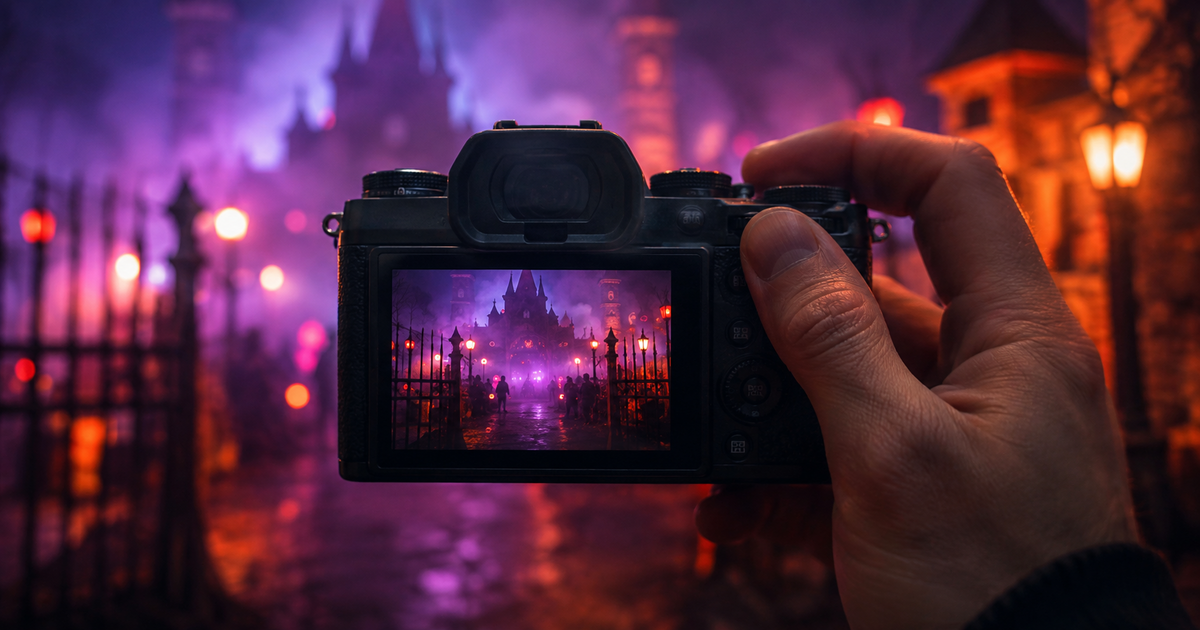
How to Take Better Photos at a Haunted House: Tips, Gear and What You Need to Know
Taking great photos at a haunted house requires knowing the attraction’s photo policy, mastering low-light phone or camera settings, and picking the right moments — queue lines, entrances, and themed exterior areas. Photography is generally not permitted inside most professional haunted house corridors, but exterior sets, photo ops, and dedicated photo stations are often available and produce the most shareable images.
Every October, millions of haunted house visitors pull out their phones to capture the experience — and most of those photos come out blurry, dark, or completely unusable. Low-light environments, fast-moving performers, and narrow corridors make haunted houses genuinely challenging photography subjects. This guide breaks down how to get the best possible photos, what rules to follow, what gear actually helps, and which moments are worth waiting for.
Know the Photography Policy Before You Go
This is the most important rule, and violating it is the fastest way to get removed from a haunted attraction. Most professional haunted houses have clearly defined photography policies:
What’s Usually Prohibited
- Photography inside haunted house corridors during active scare operation
- Flash photography near scareactors or other guests
- Video recording of haunted house scenes (protects trade-secret set designs)
- Use of tripods or stabilizer rigs inside mazes
What’s Usually Permitted
- Photography in queue line areas, front-of-house, and exterior themed sets
- Designated photo ops and character meet-and-greet moments
- Scare zone photography (outdoor themed areas between mazes)
- Professional-style photo stations if the attraction offers them
Check the attraction’s website or call ahead before your visit. Most large haunted attractions list photography policies on their FAQ or visit info pages. When in doubt, ask staff before raising your phone inside a corridor.
Mastering Low-Light Photography on a Smartphone
The exterior and queue areas of a haunted house are where most guest photography happens, and these environments are still challenging — deep shadows, colored accent lights, fog machines, and moving subjects. Here’s how to get usable images from your phone:
Use Night Mode
Every major smartphone released in the past three years has a dedicated Night Mode (iPhone) or Night Sight (Pixel) or Pro Night (Samsung) feature. Activating Night Mode allows the sensor to gather significantly more light over a longer exposure — ideal for low-light queue lines and exterior set photography. The tradeoff is a 1-3 second capture window, so subjects (and you) need to hold still. Night Mode is not suitable for moving subjects but works exceptionally well for architectural and static set photography.
Lock Focus and Exposure
In most smartphone cameras, pressing and holding on your subject locks both focus and exposure. This prevents the camera from continuously adjusting when the scene changes — a common cause of blurry or inconsistently exposed photos in complex lighting environments. Lock onto your subject, then capture.
Avoid Digital Zoom
Digital zoom degrades image quality significantly in low-light conditions. If you need to get closer to a detail or a scareactor in a photo op moment, physically move closer rather than zooming. If you have a phone with a dedicated optical zoom lens (most modern flagship phones do), use that lens rather than digital zoom on the primary camera.
Use Burst Mode for Moving Subjects
When photographing friends reacting to scares or scareactors in motion, burst mode (holding the shutter button) captures multiple frames per second and dramatically increases the chance of a sharp, well-timed image. Review the burst set afterward and select the best frame.
Camera Recommendations for Haunted House Photography
Most haunted house visitors photograph on smartphones, and modern flagship phones produce excellent results in the exterior/queue contexts where photography is permitted. If you carry a dedicated camera:
What Works Well
- Mirrorless cameras with fast lenses: A 35mm or 50mm f/1.8 lens allows significant light gathering without flash — ideal for available-light haunted atmosphere photography.
- Wide aperture primes (f/1.4-f/2.0): These lenses capture more ambient light than kit zooms and produce cleaner images in low-light without raising ISO to noise-inducing levels.
What to Avoid
- Large DSLRs and prominent lens setups: They attract staff attention, slow down queue movement, and draw complaints from other guests. Compact cameras and phones draw far less friction.
- External flashes: Even with permission to photograph, external flash units are disruptive to other guests’ experiences and typically prohibited.
Best Photography Opportunities at a Haunted House
The Exterior and Facade
Haunted attractions invest significant resources in facade design — the exterior build sets the atmosphere before guests even enter. The facade is almost always photography-permitted and offers the most architecturally dramatic images of the visit. Arrive during golden hour for natural light if the attraction opens at dusk, or wait until after dark when exterior lighting is fully activated.
Queue Line Theming
Professional haunted attractions theme their queue line environments to extend the narrative before entry. Detailed props, signage, actor appearances, and ambient lighting in queue areas create authentic atmosphere photography without the restrictive environment of the corridor interior.
Designated Photo Ops and Scare Zones
Most large attractions offer either a staffed photo station at the exit or defined photo op moments within the experience. Scare zones at theme park Halloween events (HHN, Halloween Haunt, etc.) are explicitly designed for guest photography — performers in scare zones expect and often enjoy being photographed.
Reaction Shots of Your Group
Some haunted houses offer photo services similar to theme park ride photos — cameras positioned in key scare moments capture genuine reactions and sell prints at exit. If the attraction offers this, it’s worth the purchase. Genuine unposed scare reactions are the most authentically memorable haunted house photographs that exist.
Social Sharing Tips
Haunted house content performs consistently well on Instagram and TikTok from September through early November. A few notes for maximizing reach:
- Tag the haunted attraction’s official account — many will repost guest content during peak season
- Use event-specific hashtags (most large attractions have official season hashtags)
- Post during peak engagement windows: Friday 6-9 p.m. and Saturday 5-8 p.m. outperform other times for Halloween content
- Video content (even 15-30 second clips of queue line atmosphere or exterior walkthroughs) outperforms static images on most platforms
Before you start snapping, review haunted house etiquette so your photos don’t disrupt the experience.
Frequently Asked Questions
Can you take photos inside a haunted house?
Most professional haunted houses prohibit photography inside active scare corridors to protect set design trade secrets and maintain the experience for other guests. Exterior areas, queue lines, and scare zones at theme park events are usually photography-permitted. Always check the specific attraction’s policy before visiting.
What camera setting is best for haunted house photos?
Night Mode on smartphones, or a wide-aperture lens (f/1.8 or wider) with ISO 1600-3200 on a mirrorless camera, are the most effective settings for low-light haunted house environments. Avoid flash — it disrupts other guests and is often prohibited.
Why do my haunted house photos always come out blurry?
Blur in low-light haunted house photos is almost always caused by camera shake during a longer-than-expected exposure. Brace your elbows against your body, use Night Mode to optimize the exposure automatically, or lean against a wall to stabilize. Burst mode helps capture a sharp frame in moving-subject scenarios.
Can you video record a haunted house?
Video recording policies are typically more restrictive than still photography policies. Most professional haunted attractions prohibit video recording of interior corridors. Exterior and scare zone video is typically permitted. Check each attraction’s specific policy before recording.
Do haunted houses have professional photos you can buy?
Some theme park Halloween events (like Halloween Horror Nights) and premium haunted attractions offer automatic in-house photography at key scare moments, similar to roller coaster ride photos. These are available for purchase at the exit and capture genuine, unposed scare reactions that are difficult to replicate.
Find haunted houses near you worth photographing this fall. Search the HauntHarvester directory for top-rated attractions by state — complete with reviews, photos, and visitor info.
As an Amazon Associate we may earn commission from qualifying purchases at no extra cost to you.
new in halloween animatronics
Our honest Spirit Halloween Mr. Dark review: a black-robed skeleton that pops up to nearly nine feet on a scissor lift for $370.99. We score it 3.9 of 5.
Our honest Spirit Halloween Electrified Corpse review: a wire-wrapped torso that violently shakes and screams overhead for $149.99. We score it 3.4 of 5.
Our honest Spirit Halloween Wind-Up Wally review: a creepy wind-up clown with a 360-degree spinning key and a pop-up scare for $185.99. We score it 3.5 of 5.
Find Haunted Houses in:
trending in haunt industry
Everything you need to know about East Coast Haunters Convention 2026 — dates, location, what to expect, haunt tours, seminars, and how to get tickets before prices increase.
HalloweenCostumes.com's 2026 Fan Design Program lets you design a real Halloween animatronic. Two winners get 10 props each plus 5% revenue. Submissions close April 30.
ShudderCon 2026 runs April 25–26 at Camp Jordan Arena in East Ridge, TN. Tickets from $15–$75. Here's the full preview for horror fans, haunt pros, and scare actors.