

How to Make a Disco Ghost: Budget DIY Lighted Yard Haunt Build
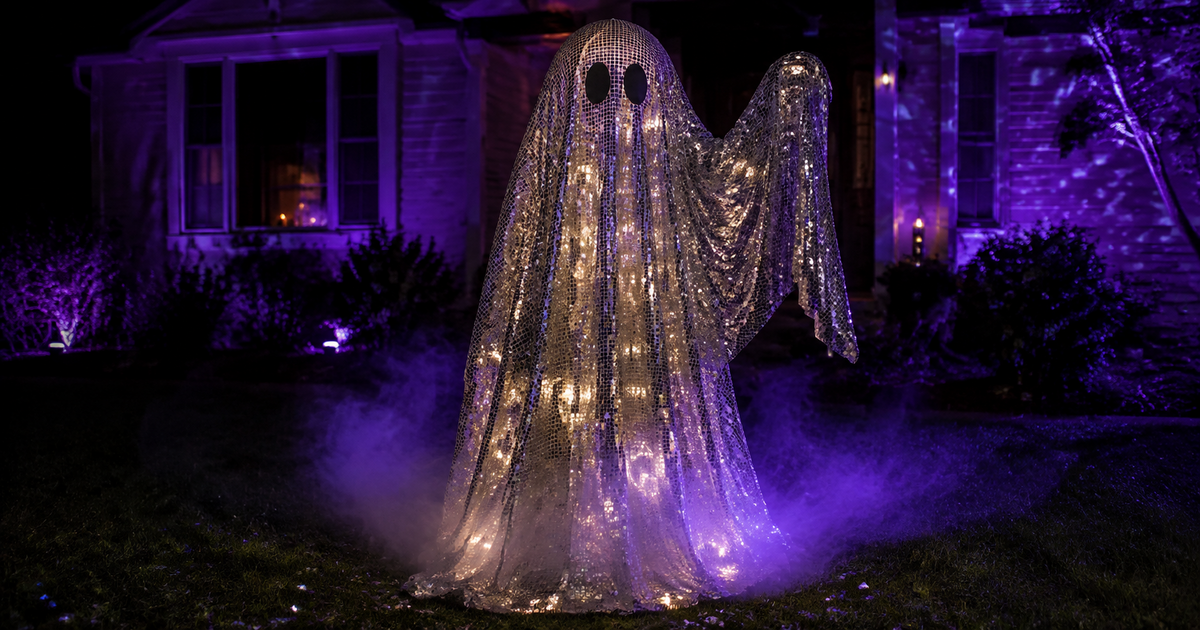
To make a disco ghost, wrap a wire tomato cage in a shimmering mirror or sequin cloth, top it with a foam ball head, and wind battery LED lights through the frame so it glows and catches the light after dark. A full-size yard version takes about 30 to 45 minutes and costs roughly $15 to $35 in materials, and the rigid cage lets it stand up to wind far better than a draped sheet.
The disco ghost is one of the highest-impact, lowest-effort yard props you can build this season. From the street it reads as a glowing, shimmering figure, but under the fabric it is nothing more than a tomato cage, a foam ball, and a string of lights you probably already own. This guide covers the materials, the step-by-step build, and the lighting tricks that make it shimmer after dark, plus a dollar-store tabletop version for porches and mantels.
What Do You Need to Make a Disco Ghost?
Everything here comes from a hardware store, a craft aisle, or a dollar store, and most of it is reusable year after year. The one part worth buying new is a rigid wire tomato cage, because it does the structural work that lets the ghost stand up on its own.
| Item | Estimated Cost | Where to Buy |
|---|---|---|
| Wire tomato cage (or rolled hardware cloth) | $5 to $10 | Home Depot, Lowe’s, garden centers |
| Mirror, sequin, or metallic fabric | $5 to $12 | Craft store, party store, Amazon |
| Foam or plastic ball for the head (6 to 8 in) | $2 to $6 | Craft or dollar store |
| Battery LED fairy or twinkle lights | $4 to $10 | Dollar store, Amazon |
| Zip ties, floral wire, or twist ties | Have on hand | Any hardware store |
| Optional: mini mirror ball, thin white sheet | $3 to $8 | Party store, Amazon |
Prices vary by store and region, so treat these as ballpark figures and check your local shelves. Optional upgrades that push the effect further: a small spotlight aimed at the ghost to bounce light off the mirror fabric, a mini rotating mirror ball tucked inside the body, and a few landscape stakes to lock the whole thing down on a windy night.
Why a tomato cage instead of a draped sheet?
A plain sheet ghost collapses the second the wind stops and disappears in the dark. A tomato cage is a ready-made skeleton: it holds a tall, tapered body shape, it stands on its own three legs, and it is open enough to light from the inside. That structure is the whole reason a disco ghost photographs like a real figure and survives a breezy October night outdoors.
How Do You Build a Disco Ghost Step by Step?
The full build takes well under an hour once your materials are cut and ready. Work on a flat surface and keep your zip ties or floral wire within reach, because most of the assembly is simply attaching pieces to the cage frame.
Step 1: Set up the cage body
Stand the tomato cage with the narrow ring up and the wide legs down, so it tapers like a robe. If your cage came with the legs pointing up, just flip it. Press the three legs into the ground for a yard build, or bend the tips flat and set it on a table for an indoor version. This tapered cone is the ghost’s body.
Step 2: Add the head
Set a foam or plastic ball on the top ring and secure it with a few zip ties, floral wire, or a stake pushed up into the ball from below. A 6 to 8 inch ball reads well in proportion to a standard tomato cage. If you want a floating look, mount the ball an inch or two above the ring so the fabric can drape into a neck.
Step 3: Wrap it in shimmer fabric
Drape your mirror, sequin, or metallic fabric over the head and let it fall loosely down the cage. Do not pull it tight. The loose folds are what catch and scatter light, which is the entire point of a disco ghost. Trim the hem so it stops just above the ground outside, or pools slightly for a tabletop piece.
Step 4: Wire in the lights
Wind a strand of battery LED fairy or twinkle lights up through the inside of the cage before you finish draping, so the bulbs sit behind the fabric. A hollow body lets the light push out through the sequins and the wire gaps at once. Keep the battery pack accessible near the base so you can switch it on and off without undressing the ghost.
Step 5: Shape the face and pose
Pinch and tuck the fabric around the head to suggest a hood and hollow face, or cut two simple eye holes and back them with black mesh for a shadowed stare. Bend the top ring slightly to tilt the head, and gather the fabric at the sides to hint at arms. Small adjustments here are what give each ghost its own posture.
How Do You Make a Disco Ghost Shimmer and Glow at Night?
Lighting is what turns a daytime craft into a yard that stops traffic. Because the body is hollow and the fabric is reflective, you get two effects at once: the LEDs glow through the cloth, and any outside light bounces off the mirror surface as scattered points.
- Warm white LEDs inside give a soft, classic spectral glow through the fabric.
- Cool white or color-changing LEDs read colder and more otherworldly, and pair well with a fogged yard.
- A small spotlight aimed at the ghost makes the sequins flash and sparkle as guests move past it.
- A mini rotating mirror ball tucked inside throws slow, drifting points of light across the fabric.
Always use battery or low-voltage LED lights rather than open flame, and keep any plug-in cords rated for outdoor use. Lighting is the highest-leverage skill in home haunting, and it carries over to every prop in your yard; our home haunt lighting guide covers color, placement, and safe outdoor power in more depth.
Can You Make a Dollar-Store Disco Ghost?
Yes, and the tabletop version is the fastest project in this guide. Skip the tomato cage entirely: start with a small ceramic or foam ghost, a plastic cup, or an upside-down bowl as the body, then glue on mirror mosaic tiles or a strip of sequin trim and set a battery tea light behind it. For a soft-body option, drape a thin white cloth over a mini mirror ball so the light shows through. These cost only a few dollars and look right at home on a porch rail, a mantel, or a windowsill.
The tabletop build is also the best way to test your fabric and lighting choices before committing to a full-size yard ghost. If one color or light setting looks flat up close, it will look flat from the street too.
How Do You Keep a Disco Ghost Standing Outside?
A tomato cage stands well on its own, but a tall, light frame can still tip in a strong gust. Push the cage legs several inches into the ground, or drive a landscape stake or length of rebar down through the center and into the soil for a solid spine. On a hard surface, weight the base with a brick or a sandbag hidden under the fabric.
The wire frame shrugs off rain, but sequin and mirror fabric can spot or peel when it stays soaked, and cheap LED battery packs are rarely waterproof. Tuck the battery pack into a small zip-top bag, and if a storm is coming, either bring the ghost in or pull the fabric and re-drape after. This is the same weatherproofing logic that applies to most yard props, so it slots neatly into a bigger plan; if you are just starting out, our beginner’s home haunt guide shows how a few builds like this add up to a full scene. Once you have the technique down, a disco ghost also pairs naturally with a classic chicken wire ghost to give a yard a whole drifting family of figures.
What Gear Helps You Build the Scene Around a Disco Ghost?
Haunt Harvester is reader-supported and may earn a commission from qualifying purchases made through links on this page, at no extra cost to you. We only feature products we would tell a friend about.
Most of what you need is probably in a closet or a dollar-store bin, and the disco ghost itself is a build, not a product you buy. But a few inexpensive, widely available pieces make the shimmer and glow land, and these are the categories worth having on hand:
- Battery LED fairy lights for the interior glow.
- Mini rotating mirror ball to scatter light across the fabric.
- Sequin or mirror fabric for the shimmering body.
- Wire tomato cage if you do not already have one from the garden.
- Small outdoor LED spotlight to make the sequins flash after dark.
Frequently Asked Questions
How long does it take to make a disco ghost? A full-size yard version takes about 30 to 45 minutes once your materials are ready, and a dollar-store tabletop version takes only a few minutes. Extra ghosts go faster because the shaping is the same each time.
How much does a disco ghost cost to make? Most people spend about $15 to $35 on a full-size yard ghost, and only a few dollars on a tabletop version if you reuse lights and fabric you already own. Costs vary by store, so check local prices.
What can I use instead of a tomato cage? Rolled hardware cloth or chicken wire, a dress form, a stack of graduated buckets, or a lamp stand all work. You just need a tall, tapered frame that stands on its own and can be lit from inside.
Can a disco ghost stay outside in the rain? The wire frame handles rain, but sequin and mirror fabric can spot when soaked and most battery LED packs are not waterproof. Bag the battery pack, and bring the ghost in or re-drape after storms.
Is a disco ghost beginner-friendly? Very. There is no cutting or wiring required beyond winding a light strand, and nothing sharp if you skip the hardware cloth. It is one of the easiest first yard builds you can attempt.
Building your yard scene this season? Find haunted houses near you for inspiration, then start your home haunt plan.

As an Amazon Associate we may earn commission from qualifying purchases at no extra cost to you.
new in halloween animatronics
Our honest Spirit Halloween Mr. Dark review: a black-robed skeleton that pops up to nearly nine feet on a scissor lift for $370.99. We score it 3.9 of 5.
Our honest Spirit Halloween Electrified Corpse review: a wire-wrapped torso that violently shakes and screams overhead for $149.99. We score it 3.4 of 5.
Our honest Spirit Halloween Wind-Up Wally review: a creepy wind-up clown with a 360-degree spinning key and a pop-up scare for $185.99. We score it 3.5 of 5.
Find Haunted Houses in:
trending in haunt industry
Everything you need to know about East Coast Haunters Convention 2026 — dates, location, what to expect, haunt tours, seminars, and how to get tickets before prices increase.
HalloweenCostumes.com's 2026 Fan Design Program lets you design a real Halloween animatronic. Two winners get 10 props each plus 5% revenue. Submissions close April 30.
ShudderCon 2026 runs April 25–26 at Camp Jordan Arena in East Ridge, TN. Tickets from $15–$75. Here's the full preview for horror fans, haunt pros, and scare actors.