

How to Make a Chicken Wire Ghost: Step-by-Step DIY Yard Haunt Guide
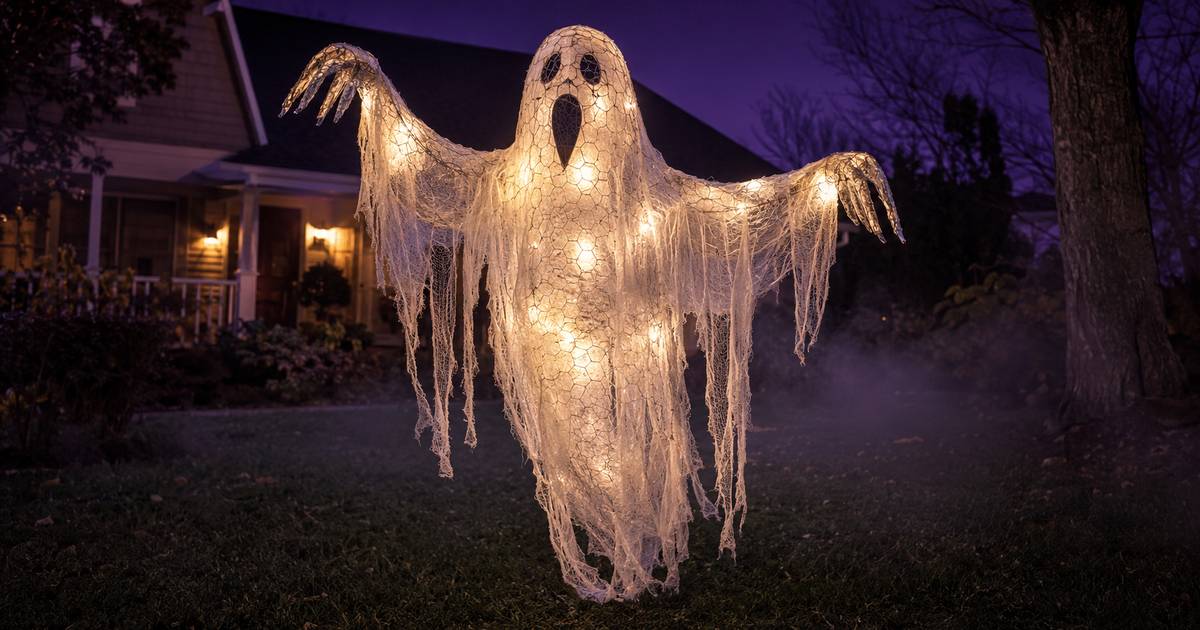
To make a chicken wire ghost, shape a roll of chicken wire into a hollow body over a head form, drape it with cheesecloth or a thin white sheet, and light it from inside with a battery LED. A basic yard ghost takes about an hour and costs roughly $15 to $30 in materials, and the wire frame lets it “float” and hold a pose that a plain draped sheet never can.
The chicken wire ghost is the rare Halloween project that photographs like it cost a fortune and actually costs almost nothing. Because the wire holds its own shape, you can pose a whole family of them drifting across a lawn, reaching from a porch, or hovering under a tree. This guide walks through the materials, the build, and the lighting tricks that make them glow after dark.
What Do You Need to Make a Chicken Wire Ghost?
Everything here is available at a hardware store or craft aisle, and most of it is reusable year after year. Buy the lightest-gauge chicken wire you can find (usually sold as poultry netting) so it bends by hand without a fight.
| Item | Estimated Cost | Where to Buy |
|---|---|---|
| Chicken wire / poultry netting | $8 to $30 | Home Depot, Lowe’s, Amazon |
| Cheesecloth or a thin white sheet | $4 to $10 | Craft store, grocery, Amazon |
| Battery LED puck or fairy lights | $3 to $16 | Dollar store, Amazon |
| Head form (foam wig head), ball, or bucket | $0 to $15 | Craft store, repurpose, or Amazon |
| Work gloves and wire cutters | $10 to $25 | Any hardware store or Amazon |
Optional extras that push the effect further: white or glow spray paint for a brighter night glow, landscape stakes or rebar to anchor a floating pose, flameless flickering candles for restless light inside the head, and black window screen for a shadowy face.
Why chicken wire instead of a plain sheet ghost?
A draped sheet collapses the moment the wind stops. Chicken wire is a skeleton, so your ghost keeps its arms raised, its head tilted, and its body hollow enough to light from within. That structure is the whole reason these props look three-dimensional in photos and hold up outdoors.
How Do You Build a Chicken Wire Ghost Step by Step?
Wear gloves the entire time. Cut chicken wire has sharp barbs, and this is the one part of the project that bites back. Work on a flat surface or lay the pieces over a trash can or chair to hold the shape while you form it.
Step 1: Form the head
Cut a section of wire about 24 inches long and press it over your head form, a bowl, a ball, or an upside-down bucket. Mold it into a smooth dome, then remove the form. The wire holds the round shape on its own. Pinch a short neck below the head so it has somewhere to sit on the body.
Step 2: Build the body tube
Roll a larger piece of wire, roughly 2 feet by 3 feet, into a cone or tube. Wider at the bottom reads as a robe; narrower reads as a tall, thin figure. Twist the cut edges together with pliers so nothing springs loose, and tuck any stray barbs inward so they do not catch fabric or fingers later.
Step 3: Add arms and a pose
Roll two smaller tubes for arms and attach them to the shoulders by weaving the cut wire ends through the body. This is where the ghost gets its personality: reach both arms forward for a lunging pose, raise one for a beckoning wave, or leave them at the sides for a quiet drifting look. Bend and re-bend freely until it feels right.
Step 4: Join head to body
Set the head on the neck and twist the wires together, or run a landscape stake up through the body and into the head to lock everything on one spine. If you want a floating ghost, this is the moment to plan your support, because a hidden stake or a line to a tree branch carries the whole weight.
Step 5: Drape and light it
Lay cheesecloth or a thin white sheet over the frame and let it fall in loose folds. Do not pull it tight; the gaps and drapes are what catch light and shadow. Tuck a battery LED puck or a knot of fairy lights inside the body, switch it on after dark, and the whole ghost turns into a soft glowing lantern.
How Do You Make a Chicken Wire Ghost Glow at Night?
Lighting is what separates a daytime craft from a yard that stops traffic. Because the body is hollow, an LED placed inside pushes light out through the fabric and the wire gaps at once.
- Warm white LED reads as a classic spectral glow and is the safest default.
- Cool white or blue looks colder and more ghostly, and pairs well with a fogged yard.
- Glow or white spray paint on the wire before draping adds a second layer of brightness so the ghost still reads from the street.
- Flickering flameless candles inside the head give a restless, uneven light that feels alive.
Always use battery or low-voltage LED lights, never open flame, and keep any plug-in cords rated for outdoor use. For a fuller scene, low-lying fog under a lit ghost is one of the best cheap upgrades in home haunting; our fog effect guide covers how to keep the fog hugging the ground where it belongs.
How Do You Keep a Chicken Wire Ghost Standing Outside?
A lightweight wire ghost will sail across the yard in a gust if you do not anchor it. Drive a landscape stake or a length of rebar into the ground and run it up through the body, or tie a near-invisible fishing line from the ghost to a porch rail or tree limb for the floating look. Weighting the base with a brick hidden under the fabric also helps on calm nights.
The wire frame itself shrugs off rain, but cheesecloth sags and yellows when it stays soaked. If a storm is coming, either pull the fabric and re-drape after, or accept a weathered, tattered look as part of the character. This is the same weatherproofing logic that applies to most yard props, so it fits neatly into a larger plan; if you are just getting started, our beginner’s home haunt guide shows how a few props like this build into a full scene.
Ideas to Take Your Ghost Family Further
Once you have the technique down, the second and third ghosts go up in minutes. Vary the heights for a family, cluster three near a DIY cemetery gate for a graveyard scene, or line a walkway so guests pass between them on the way to the door. A child-sized ghost holding a real toy lantern is a small, sharp detail that people remember.
Shop the build
- Chicken wire (poultry netting) — the frame
- Cheesecloth — the drape
- Warm-white battery fairy lights — the glow
- Foam head form — shapes the hood
- Cut-resistant gloves + wire cutters — the tools
Frequently Asked Questions
How long does it take to make a chicken wire ghost? A basic single ghost takes about 45 minutes to an hour once you have your materials cut and ready. Additional ghosts go faster because you already know the shaping tricks.
How much does a chicken wire ghost cost to make? Most people spend $15 to $30 per ghost, and less if you reuse an old sheet and lights you already own. The chicken wire roll is the main cost and makes several figures.
Do I need a head form to shape the head? No. A bowl, a ball, a balloon, or an upside-down bucket all work fine. The wire keeps whatever round shape you press it into, so anything head-sized will do.
Can a chicken wire ghost stay outside in the rain? The wire frame handles rain, but the fabric sags and discolors when soaked for long. Re-drape with fresh cheesecloth after storms, or lean into the tattered look on purpose.
Is chicken wire safe to work with? It is as long as you wear work gloves and cut carefully. The freshly cut edges are sharp, so tuck barbs inward and keep the project away from young kids during the build.
Building your first yard scene this year? Start your home haunt plan
new in halloween animatronics
Our honest Spirit Halloween 5 Ft 8 In Valak (The Nun) animatronic review: a $325.99 officially licensed lunging demon nun scored 4.0 out of 5 for scare.
Our honest Spirit Halloween LED Red and Black Jumping Spider review: a $49.99 motion-activated jump prop with light-up eyes, scored 3.3 out of 5 on value.
Home Depot's 12 ft Skelly sells out fast every year. See when it restocks in 2026, the $299 price, and how to buy the giant skeleton before it is gone.

Paid link: As an Amazon Associate we may earn commission from qualifying purchases at no extra cost to you.
Find Haunted Houses in:
trending in haunt industry
Everything you need to know about East Coast Haunters Convention 2026 — dates, location, what to expect, haunt tours, seminars, and how to get tickets before prices increase.
HalloweenCostumes.com's 2026 Fan Design Program lets you design a real Halloween animatronic. Two winners get 10 props each plus 5% revenue. Submissions close April 30.
ShudderCon 2026 runs April 25–26 at Camp Jordan Arena in East Ridge, TN. Tickets from $15–$75. Here's the full preview for horror fans, haunt pros, and scare actors.