

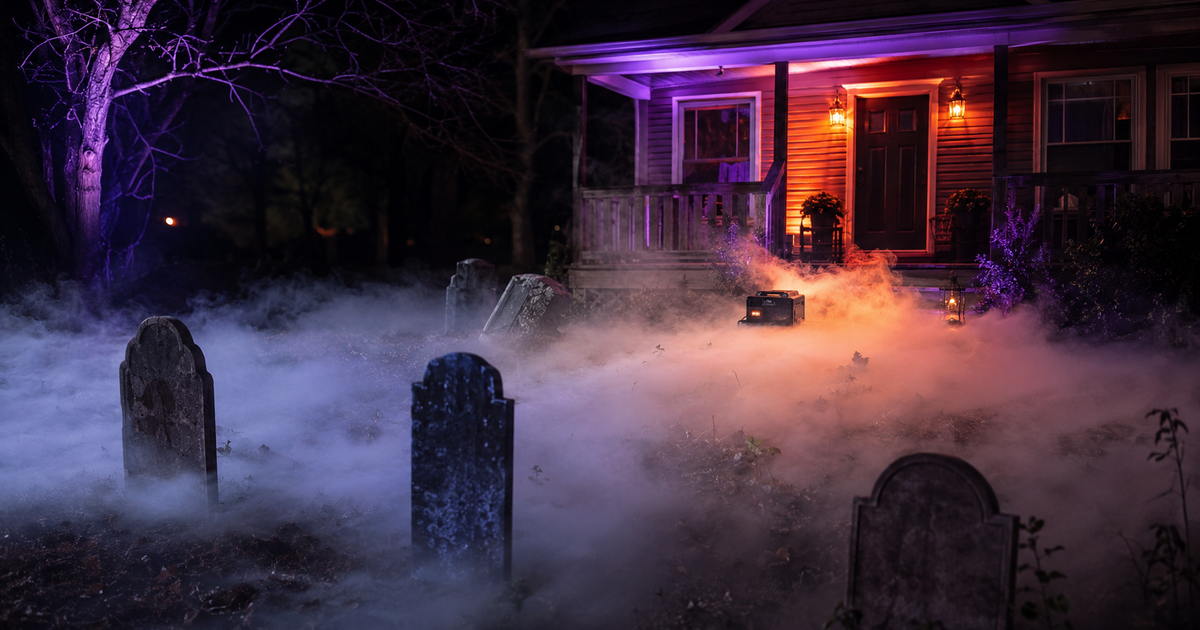
How to Build a Fog Effect for Your Home Haunt
To build a fog effect for your home haunt, you need a fog machine ($25–45) connected to a DIY fog chiller—a cooler filled with ice that the fog passes through before entering your space. The chilling process causes the fog to become dense and low-lying rather than rising into the air, producing the classic ground-hugging horror atmosphere. Total cost to build the complete setup is typically under $60.
Nothing transforms a haunted space faster than fog. Lighting creates atmosphere; fog makes it three-dimensional. A well-fogged haunt changes how guests perceive every element in it—props emerge from mist rather than sitting in empty air, sightlines collapse in ways that pure darkness can’t achieve, and the sensory effect of walking through fog triggers discomfort responses that work even in guests who’ve been through dozens of haunts.
This guide covers everything you need to create the right fog effect for your home haunt: choosing your machine, building a DIY fog chiller for ground-level fog, working with dry ice, and avoiding the most common fog setup mistakes.
Understanding the Two Types of Fog Effects
Not all fog is the same. Understanding the two primary types helps you choose the right approach for your space:
Standard Rising Fog
A standard fog machine produces hot water vapor that rises and dissipates through the air. This type of fog creates a general hazy atmosphere—think concert smoke or stage fog. It’s effective for filling large spaces and obscuring sightlines at eye level and above. Standard fog uses basic “fog juice” (water-based fluid) and is the simplest setup. Limitations: it rises, so guests can see their feet, and it looks more theatrical than naturally atmospheric.
Low-Lying Ground Fog
Ground fog—the creeping, ankle-level fog that moves across floors like a living thing—is produced by chilling standard fog before it exits the machine. The chilling process makes the fog denser than the surrounding air, so it sinks and spreads at floor level rather than rising. This is the fog effect in every professional haunted attraction, every horror film cemetery scene, and every atmospheric Halloween display you’ve admired. It requires a fog chiller and is the technique this guide focuses on.
Building a DIY Fog Chiller
A fog chiller is essentially a box of ice that your fog machine output passes through before entering your haunt space. You can buy commercial fog chillers for $40–100, or build one for under $15 with a trip to a hardware or grocery store.
Materials Needed
- A large plastic cooler (any size works; a 48-qt cooler produces better results than a small personal cooler)
- PVC pipe — two 3-inch diameter sections, 6 inches long (available at any hardware store, ~$2–3)
- A drill with a hole saw bit matched to your PVC diameter
- Aluminum dryer vent flex hose (4-inch diameter, 8 feet) for connecting your fog machine to the chiller — ~$8
- Zip ties and duct tape for sealing connections
- Ice — regular bagged ice works well; dry ice produces denser, longer-lasting fog (see below)
Construction Steps
- Drill two holes in opposite ends of your cooler, sized to accept your PVC pipe sections. One end is the fog input (from your machine), the other is the fog output (into your haunt).
- Insert PVC pipe sections into both holes and seal with duct tape or silicone caulk to prevent air gaps.
- Fill the cooler with ice. A wire rack or aluminum mesh placed above the ice level (so fog passes through ice rather than over it) significantly improves chilling efficiency.
- Connect your fog machine’s output to the chiller’s input pipe using the flex dryer vent hose. Seal the connection with zip ties and duct tape.
- Point the output pipe toward the floor of your haunt space. The chilled fog will sink and spread at ground level.
Choosing Your Fog Machine
For a home haunt with a DIY chiller, a 400W fog machine ($25–35) is the standard starting point. Key specs to evaluate:
- Output (cubic feet per minute): Higher output fills space faster but drains fluid faster. 400W machines produce about 800 CFM—adequate for a two-car garage.
- Warm-up time: Budget machines take 3-5 minutes to reach operating temperature. Position your machine out of guest view and pre-warm before your first group arrives.
- Timer/remote: A wired timer ($8–10) or wireless remote ($12–15) lets you control output without being visible to guests. Essential for any scare-actor-operated haunt.
- Fluid compatibility: Standard water-based fog fluid works in virtually all consumer machines. Avoid “haze” or “fast dispersing” fluid variants—these are designed for concert-style applications and don’t chill effectively.
Using Dry Ice for Superior Ground Fog
Dry ice produces the densest, most persistent ground fog of any method—no fog machine required. Dry ice sublimates (converts directly from solid to gas) when exposed to warm water, producing a thick CO2-based fog that sinks rapidly and holds its low-lying character much longer than chilled water-vapor fog.
Dry Ice Fog Method
Place dry ice chunks in a bucket or metal container. Pour warm (not boiling) water over the dry ice. Fog begins immediately and lasts until the ice is exhausted. Redirect the output using a cardboard or PVC tube angled toward the floor. A single 5-lb block of dry ice ($1–2 per pound at many grocery stores and gas stations) produces approximately 10-15 minutes of dense ground fog.
Dry Ice Safety
Handle dry ice with thick gloves—direct skin contact causes frostbite in seconds. Never store dry ice in a sealed container; CO2 pressure will build dangerously. Ensure your haunt space has adequate ventilation—ground-level CO2 accumulation can be a safety concern in enclosed spaces with heavy dry ice use. For professional haunt applications with extended dry ice use, monitor CO2 levels and maintain air circulation.
Fog Placement Strategy
Where you position your fog output determines its effectiveness:
- Corner placements allow fog to accumulate and build density before spreading across the room. A single corner chiller can fill a 400 sq ft space with consistent ground coverage.
- Aim output at the floor, not horizontally into the space. Ground-struck fog spreads naturally. Horizontally-aimed fog tends to rise before it reaches the opposite end of the room.
- Avoid high-traffic positions directly in guest walkways—body heat and movement from passing guests disrupts low-lying fog rapidly. Position sources at the sides of corridors, not in the center.
- Cross-ventilation kills ground fog. Seal any gaps in your haunt walls that allow air currents through. Even a small draft can clear your ground fog within minutes.
Common Fog Setup Mistakes and How to Fix Them
Fog rises instead of creeping: Your chiller ice has melted—replace it. Also check for air leaks in your cooler-to-machine connection allowing warm air to mix with chilled output.
Fog machine runs out quickly: Standard 400W machines use approximately 1 quart of fluid per 2-3 hours of continuous operation. Buy at least 1 quart per event night. Store fluid at room temperature.
Fog clears too quickly: Drafts in your space are dissipating the fog. Seal your haunt space more thoroughly, and avoid high-powered fans in fog zones. Increase your machine’s output timer frequency.
Fog smells chemical: You’re using the wrong fluid type, or your machine’s heating element has residue from a previous fluid type. Run plain distilled water through the machine for one full cycle to flush it before switching fluids.
Frequently Asked Questions
How much does a fog chiller cost to build?
A DIY fog chiller using a plastic cooler, two PVC pipe sections, and flex vent hose costs $12–18 in materials (plus the cost of a cooler if you don’t own one). Commercial fog chillers range from $40–100 and offer more polished construction but no performance advantage over a well-built DIY version.
What’s the difference between dry ice fog and fog machine fog?
Dry ice produces denser, longer-lasting ground fog but requires sourcing dry ice (available at many grocery stores and gas stations) and careful safety handling. Fog machine fog with a chiller is more convenient for multi-hour haunts and produces consistent output. Many professional haunts use both: fog machines for large-volume fill and dry ice for key scene areas requiring maximum density.
Is fog machine fluid safe?
Standard water-based fog fluid is non-toxic and FDA GRAS (Generally Recognized as Safe) for most formulations. However, concentrated exposure in enclosed spaces can irritate respiratory systems, particularly for guests with asthma. Ensure adequate ventilation and post a warning for guests with respiratory sensitivities. Never use oil-based or glycol-heavy fluids in consumer machines—these require professional equipment to atomize safely.
How often do I need to refill the chiller ice?
Standard ice in a well-insulated cooler lasts approximately 3-4 hours before fog quality degrades noticeably. For events longer than 3 hours, plan for a mid-event ice refill or use a larger cooler with more ice capacity. Dry ice lasts longer than water ice but requires more careful handling during replacement.
Get the full picture on building your home haunt. Plan your layout, design your soundscape, and stay under budget—all on HauntHarvester.
new in halloween animatronics
Our honest Spirit Halloween Night Terror review: a $99.99 six-foot cackling animatronic with glowing orange eyes, scored 3.5/5 across five categories.
Our honest Spirit Halloween 5 Ft Back Bend Bonnie review: a $194.99 animatronic that bends backward with bone-snapping sounds and screams, scored 3.7/5.
Our honest Spirit Halloween Scary Sitting Scarecrow review: a $119.99 candy-bowl pop-up greeter scored 3.7/5 on haunt impact, motion, sound and build.

Paid link: As an Amazon Associate we may earn commission from qualifying purchases at no extra cost to you.
Find Haunted Houses in:
trending in haunt industry
Everything you need to know about East Coast Haunters Convention 2026 — dates, location, what to expect, haunt tours, seminars, and how to get tickets before prices increase.
HalloweenCostumes.com's 2026 Fan Design Program lets you design a real Halloween animatronic. Two winners get 10 props each plus 5% revenue. Submissions close April 30.
ShudderCon 2026 runs April 25–26 at Camp Jordan Arena in East Ridge, TN. Tickets from $15–$75. Here's the full preview for horror fans, haunt pros, and scare actors.