

How to Plan Your Home Haunt Layout From Scratch
Haunt Harvester is reader-supported. If you buy through links on this page we may earn a commission at no extra cost to you.
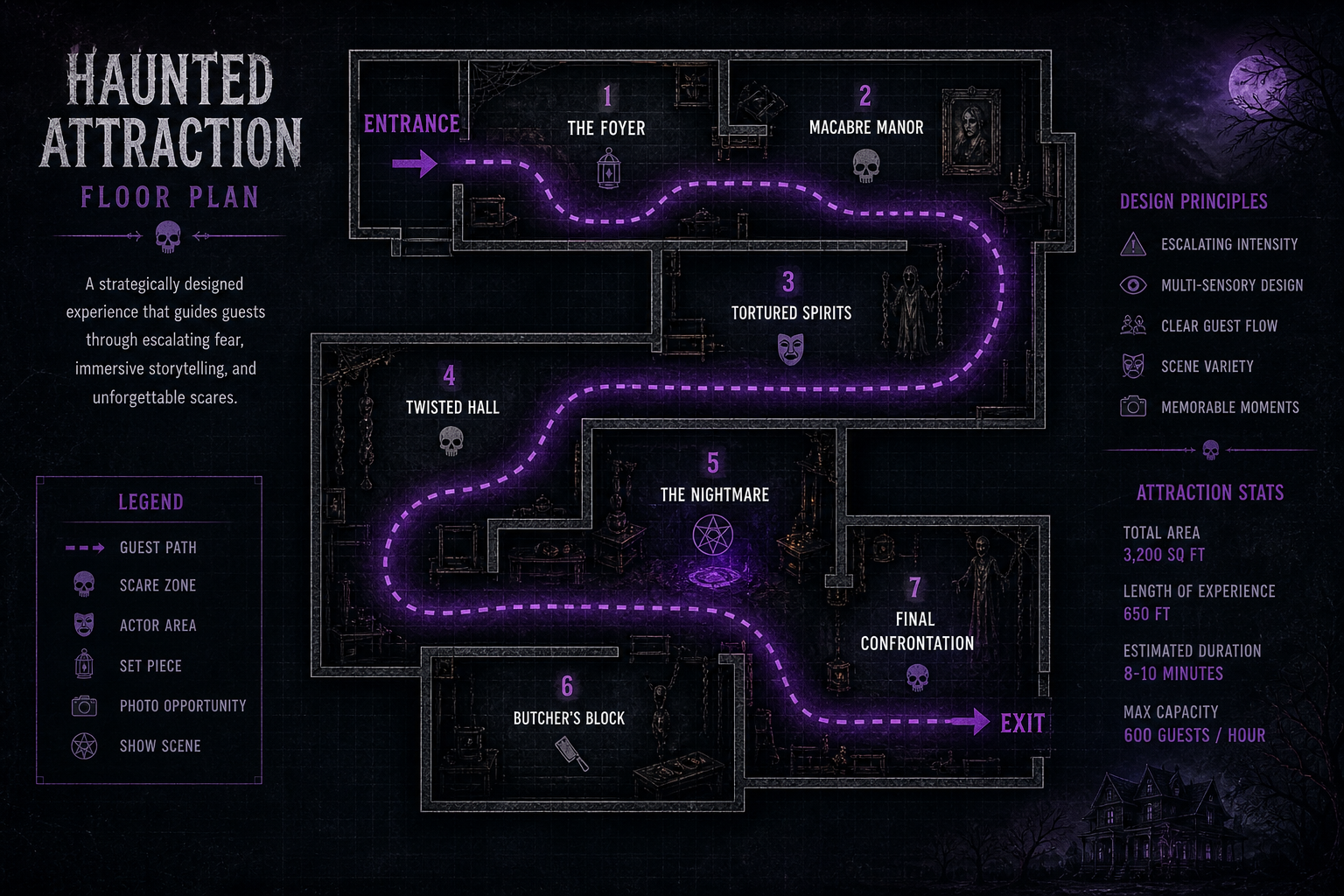
Planning a home haunt layout from scratch starts with mapping your available space, identifying a guest flow path, and dividing that path into scare zones with escalating intensity. Sketch your space on graph paper first, design the flow so guests move forward (never back-track), and position scares at the sides and rear—never the front—to push guests deeper into the attraction. Strategic lighting, fog, and sound do more atmospheric work than any single prop.
Most first-time home haunters make the same mistake: they buy a bunch of props, arrange them around the yard, and wonder why it doesn’t feel like a real haunt. The difference between a random Halloween decoration display and an actual haunted experience is intentional layout design. Professional haunts are engineered environments. Yours can be too—even if you’re working with a two-car garage, a backyard, or a basement hallway.
This guide walks you through the complete process of planning a home haunt layout from scratch, from your first sketch to your final walk-through.
Step 1: Assess and Map Your Space
Before you buy a single additional prop, sit down with graph paper and map every square foot of your available space. Include your entrance point, all obstacles (trees, posts, furniture), power outlets, and your natural exit point. Measure accurately—the difference between a 10-foot and 14-foot corridor changes your scare placement math significantly.
Common home haunt spaces and their typical flow challenges:
- Garage: Single large space that requires interior walls or dividers to create corridors. Black plastic sheeting on PVC pipe frames is the industry standard for cheap, reusable wall construction.
- Backyard: Natural flow is possible with rope-lit paths, but you need light discipline—too much ambient light kills atmosphere. Use landscape fabric or temporary fencing to channel guest flow.
- Basement: Low ceilings and tight spaces work in your favor atmospherically. The natural dampness and limited sight lines are assets. Focus on managing throughput in narrow passages.
- Front yard / porch: Works best as a single-zone “greeting haunt” rather than a full walk-through. One anchor animatronic, strategic lighting, and sound design can make a front yard display genuinely unnerving.
Step 2: Design Your Guest Flow Path
The single most important layout rule: guests should never back-track. A haunted attraction that requires visitors to reverse course destroys the psychological tension you’ve built. Your flow path should be a loop or a through-line from entrance to exit.
Design principles for flow:
- Use blind corners aggressively. A sharp turn into an unknown space is free tension. Every 90-degree corner you can engineer into your layout is a scare opportunity.
- Vary the corridor width. Alternate between tight (3-4 foot) passages and sudden wide-open spaces. The contrast is psychologically powerful—the relief of open space is immediately followed by the terror of exposure.
- Control sightlines. Guests should never be able to see more than 10-15 feet ahead of them. Longer sightlines reduce tension; short sightlines maximize it.
- Build in pause points. Locations where guests naturally slow or stop—a doorway, a sharp corner, a scene that requires them to look around—are your best scare positions.
Step 3: Define Your Scare Zones
Divide your layout into 3-5 distinct zones, each with a different theme or intensity level. Effective zone design follows an escalation curve: start atmospheric and suspenseful, build to high-intensity scares in the middle third, and deliver your biggest moment two-thirds of the way through. The final third should feel like a slightly breathless denouement—resolved but unsettled.
A simple three-zone framework for a garage haunt:
- Zone 1 — Entry: Low-intensity atmosphere. Fog, ambient sound, dim lighting. Let guests’ eyes adjust to the dark before hitting them with anything.
- Zone 2 — Build: Increasing tension. Sudden noises, props that move, lighting that flickers. Scare actors (if using) make their first appearances here.
- Zone 3 — Climax: Your highest-intensity moment. Best animatronic, best practical effect, best scare actor hide. Place this two-thirds through the route, not at the very end.
Step 4: Place Your Scares Correctly
Professional haunt designers follow a counterintuitive rule: scare from the sides, back, and above—never from the front. A scare coming from directly ahead of a guest stops their forward momentum and can cause guests to reverse. A scare from the side or behind pushes them forward, maintaining flow.
Practical placement tips:
- Position scare actors in alcoves, behind angled walls, or in false panels on the guest’s right or left side.
- Use overhead elements (hanging props, dropping effects, sudden ceiling lighting) to create vertical scares.
- Reserve your animatronic(s) for the most dramatic position in your layout—often a corner reveal where the guest turns and comes face-to-face with the prop.
Step 5: Layer Atmosphere Throughout
Layout is the skeleton; atmosphere is the flesh. Three elements do more work than any prop purchase:
- Lighting: Aim for 80% darkness with targeted highlights on key props and scare positions. Purple, red, and cool blue LED strips ($15–25 per 16-ft strip) are your foundation. Flickering bulbs add motion without any mechanical prop.
- Fog: Low-lying fog from a chiller-equipped fog machine transforms any space. Without it, your props sit in empty air. With it, they emerge from atmosphere. (See our full guide on building a fog effect for your home haunt.)
- Sound: Design a soundscape for each zone, not a single looping track for the whole haunt. Zone 1 might have distant wind and creak effects; Zone 3 gets aggressive score and proximity-triggered jump sounds.
Step 6: Walk It Before You Open It
Before your first guests arrive, walk the entire route twice: once as a guest would experience it (forward, at pace), and once backward to identify positions from which your scare placements are visible too early. Common issues to fix on your walk-through include props visible from the entrance that give away later scares, lighting that’s too even (remove brightness, not add it), and flow bottlenecks where guests will stack up.
Frequently Asked Questions
How much space do I need for a home haunt?
A single-car garage (10×20 feet) is enough for a compelling 3-zone home haunt using corridor construction techniques. A two-car garage or backyard space of 20×30 feet or more allows for a more elaborate multi-zone layout. The design principles are the same regardless of scale.
How do I build walls in a home haunt?
The most common DIY method uses 1-inch PVC pipe as a frame (available at hardware stores for $1–2 per foot) with black plastic sheeting stapled or zip-tied over it. This creates sturdy, lightweight, reusable walls. T-joint and elbow connectors allow any configuration. A full wall frame system for a two-car garage can typically be built for under $150 in materials.
How do I manage sound in multiple zones?
Use separate Bluetooth speakers in each zone, playing zone-specific audio from a playlist or horror sound app. Keep volume balanced so ambient sound in Zone 1 doesn’t compete with the Zone 3 climax sequence. Position speakers facing away from zone transitions to minimize audio bleed.
Should I use scare actors or just props?
Both. Props provide consistent scares even during slow moments; actors add adaptability, interaction, and the uniquely effective scares that only a human presence can deliver. Even one well-placed scare actor dramatically elevates a prop-only haunt. Start with props and add actors as your haunt grows.
Browse the Haunt Harvester Directory for inspiration from the country’s top professional haunts.

As an Amazon Associate we may earn commission from qualifying purchases at no extra cost to you.
new in halloween animatronics
Our honest Spirit Halloween Doomsday Duo review: a two-figure, outdoor-rated gas-mask reveal we score 3.9/5. See if this 2026 scene anchor is worth it.
Home Depot's 11 ft Giant Mummy animatronic (2026) is a poseable under-$300 yard giant. See its specs, price, where to buy it, and whether it is worth it.
Spirit Halloween's Trash Bandit is a 3 ft 7 in radioactive-raccoon animatronic for 2026 at $149.99, with a pop-up scare, growls, and glowing blacklight decay.
Find Haunted Houses in:
trending in haunt industry
Everything you need to know about East Coast Haunters Convention 2026 — dates, location, what to expect, haunt tours, seminars, and how to get tickets before prices increase.
HalloweenCostumes.com's 2026 Fan Design Program lets you design a real Halloween animatronic. Two winners get 10 props each plus 5% revenue. Submissions close April 30.
ShudderCon 2026 runs April 25–26 at Camp Jordan Arena in East Ridge, TN. Tickets from $15–$75. Here's the full preview for horror fans, haunt pros, and scare actors.