

Haunted House Trends 2026: What’s Changing This Season
The haunted house industry is in the middle of a design revolution. What worked five years ago — fog machines, jump scares from dark corners, actors in rubber masks — still works. But the venues driving record attendance and social media volume in 2026 are doing something more ambitious: building environments where guests do not just walk through a story, but inhabit one. Understanding the trends reshaping haunted attractions this year matters whether you are a visitor choosing where to spend your October or an operator planning your next capital investment.
Hyper-Realistic Animatronics Are Redefining What “Scary” Looks Like
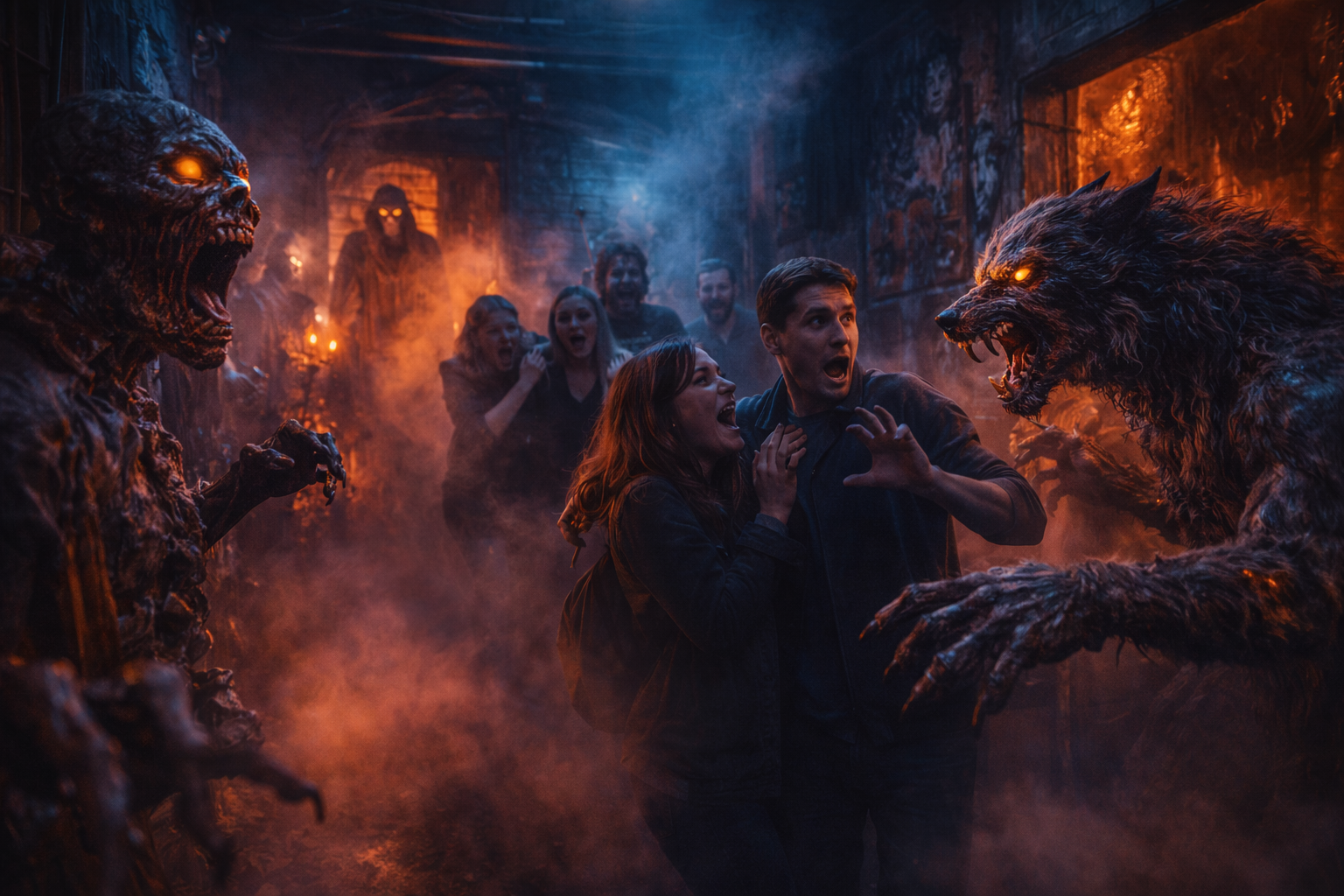
The leap in animatronic quality between 2020 and 2026 is difficult to overstate. Motion control systems, silicone skin textures, and high-fidelity audio processing have produced props that, in the right lighting and environment, cross the uncanny valley in ways that genuinely unsettle guests. The Home Depot 2026 collection — with pieces like the 8-foot Wyvern and the app-controlled Ultra Skelly — reflects what has become the new consumer-grade baseline. Professional haunt-grade animatronics have moved far beyond even that.
The expectation among guests who visit multiple haunts per season has shifted: a venue that has not updated its animatronics in three or more years now reads as dated against the current standard.
Immersive Participation Is Replacing Passive Observation
The old haunted house model was linear: guests walked from room to room, actors scared them, they moved on. The venues driving the sharpest growth in 2026 are building experiences where guests are active participants — given roles, confronted with choices, or required to complete tasks to progress. This shift borrows heavily from escape room design and immersive theater, and it is fundamentally changing the relationship between the attraction and the guest.
Multi-Night Scream Parks Continue to Outperform Single-Attraction Venues
Scream parks — multi-attraction operations offering a full evening across multiple haunts, hayrides, and entertainment on a single property — have shown consistently stronger attendance growth than single-attraction venues. For visitors, this trend means increasingly strong options for full Halloween evenings. For operators, it has created a bifurcation between large-scale entertainment destinations and smaller boutique haunts.
Insurance and Compliance: The Operational Challenge No One Talks About
A theme that surfaced prominently at the 2026 State of the Industry Seminar, covered in detail by Haunted Attraction Network, is insurance. The coverage environment for haunted attractions has become progressively more difficult, with premiums rising and some carriers exiting the market segment. For visitors, this is relevant as a signal about where to spend your money: HAA-certified venues tend to be better positioned to manage these pressures.
Technology Is Entering the Guest Experience Layer
RFID wristbands, app-based queue management, personalized scare profiles, and post-visit digital content are moving from novelty to operational infrastructure at leading attractions. Some venues now allow guests to pre-select their scare intensity level — communicating preferences to actors before they enter. The direction is clear: the haunted house visit of 2030 will involve more touchpoints before and after the walk-through than the experience itself.
What This Means If You Are Choosing a Haunt This Season
The gap between the best haunted attractions and the merely adequate ones has never been wider. Checking fear-level ratings, looking for recent animatronic investment signals, reading reviews that specifically mention immersion quality, and filtering for HAA-certified venues are all meaningful signals in a crowded market.
Frequently Asked Questions
What are the biggest trends in haunted houses for 2026?
Hyper-realistic animatronics, immersive participatory formats, scream park multi-attraction models, and technology integration are the defining trends of 2026.
How have haunted house animatronics improved recently?
Motion control systems, silicone skin textures, and audio processing have advanced significantly. The gap between consumer-grade and professional haunt-grade props has narrowed while the overall quality ceiling has risen substantially.
What is immersive haunted house design?
Immersive design refers to haunted attractions where guests are active participants rather than passive observers — given roles, confronted with choices, or engaged by actors who respond to their specific behavior.
Are haunted houses getting more intense or less intense?
Both, simultaneously. The top end has become more intense through immersive formats. The family-friendly segment has expanded with more multi-intensity programming. The market is stratifying rather than moving in a single direction.
Explore the best-rated haunted attractions in your area — including venues investing in the immersive and animatronic trends shaping 2026 — through the Haunt Harvester directory. Or dive deeper into our ultimate haunted house guide for everything you need to know before visiting.
new in halloween animatronics
Our Spirit Halloween Emily Corpse Bride review: a $315.99 licensed, life-size animatronic scored 3.9/5 for servo motion, film dialogue, build and presence.
How much do Halloween animatronics cost? A price guide by size and type, from under-$50 props to $700 giants, with what drives the price and how to save.
A first look at Grandin Road's Halloween Haven 2026: premium animatronics, witches, and lit yard pieces from $69 to $699, plus which pieces to buy first.

Paid link: As an Amazon Associate we may earn commission from qualifying purchases at no extra cost to you.
Find Haunted Houses in:
trending in haunt industry
Everything you need to know about East Coast Haunters Convention 2026 — dates, location, what to expect, haunt tours, seminars, and how to get tickets before prices increase.
HalloweenCostumes.com's 2026 Fan Design Program lets you design a real Halloween animatronic. Two winners get 10 props each plus 5% revenue. Submissions close April 30.
ShudderCon 2026 runs April 25–26 at Camp Jordan Arena in East Ridge, TN. Tickets from $15–$75. Here's the full preview for horror fans, haunt pros, and scare actors.