

How to Build a Creepy Carnival Scene for Halloween: Clowns, Lights, and Props
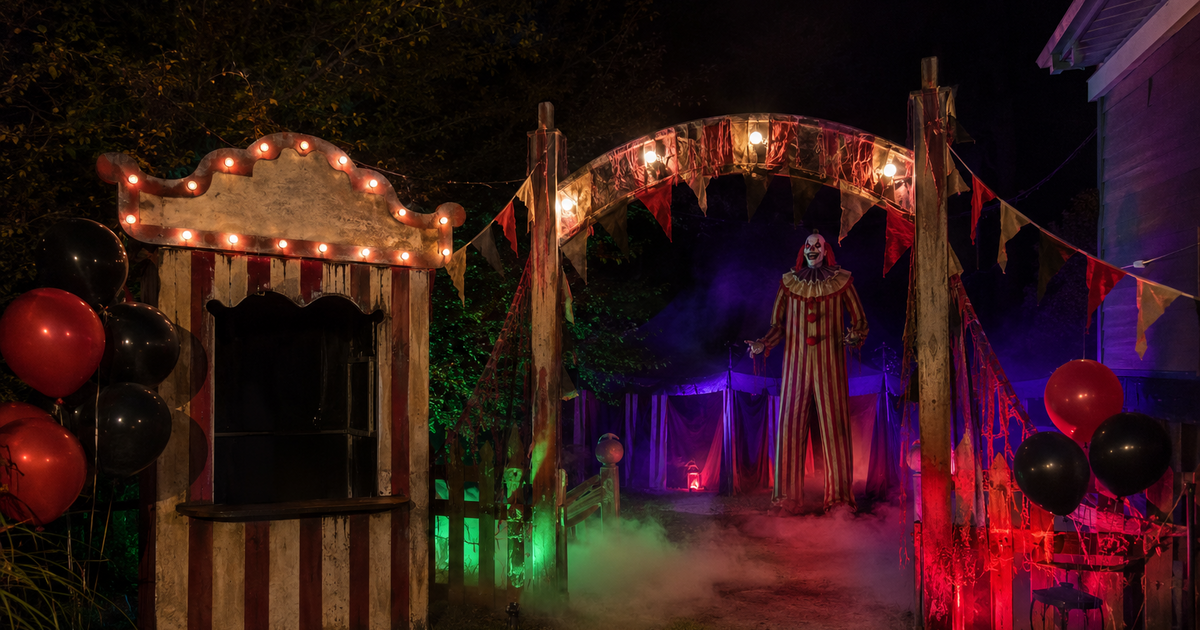
To build a creepy carnival scene, commit to one idea: a cheerful place gone wrong. Start with theming that says “carnival” from across the yard — bold stripes, a ticket booth or marquee, string lights and balloons — then twist it with fog, saturated red and green lighting, distant calliope music, and a clown or two lurking where you least expect them. The contrast between playful and sinister is what makes a haunted midway land.
A killer-clown carnival is one of the most fun scenes a home haunter can build because the raw materials are cheerful. You are not buying gloom; you are buying party supplies and then breaking them. Stripes, balloons, string lights, and carnival music are inherently friendly, and that is exactly why they unsettle people once you add fog, wrong colors, and a grinning figure standing too still. Clowns are also having a moment: our 2026 clown Halloween guide tracks how far the trend has spread across attractions and retail this year.
What makes a carnival scene creepy instead of just colorful?
The whole effect runs on contrast. A normal carnival is bright, loud, and welcoming; a haunted one keeps just enough of that to feel familiar, then poisons it. Faded and torn bunting reads as abandoned. Cheerful music slowed down or played from a hidden speaker sounds wrong. A smiling clown face lit from below stops being funny. Aim for “this used to be fun” rather than generic gore, and the scene does the psychological work for you.
| Element | What it does | Starting point |
|---|---|---|
| Theming | Signals “carnival” instantly | Ticket booth or marquee, striped fabric, balloons |
| Lighting | Turns friendly into sinister | Saturated red, green, and purple spots |
| Clowns | The threat; the focal scare | 1–2 figures, plus jump-scare faces |
| Fog and sound | Depth and dread | A fog machine and hidden speaker |
How do you build the carnival setting?
Establish the place before you add the scares. A simple frame — a ticket booth by the walkway, a lit marquee or a hand-painted “Step Right Up” sign, and a striped backdrop or entrance — tells visitors they are entering a midway before they see a single clown. Red-and-white or black-and-white striped fabric is the cheapest, highest-impact detail you can add, so use it on the booth, a tent flap, or a path border.
From there, layer in carnival cues: clusters of balloons (a few deflated or blackened), vintage-style string lights, a marquee arrow, and a defined pathway that funnels people past your scares. If you are laying out a walk-through or a larger yard, our guide to planning your home haunt layout from scratch covers sightlines and traffic flow that keep a carnival path from turning into clutter.
How should you light a haunted carnival?
Lighting is what separates a birthday party from a nightmare. Skip flat white and go saturated and directional.
- Use carnival colors, wrong. Deep red, sickly green, and purple read as a midway that has curdled. A single warm amber accent can suggest old bulbs without softening the mood.
- Uplight the clowns. Hide small spotlights low and angle them up at clown faces so the shadows fall upward — the classic way to make a grin look predatory.
- Add flicker and motion. Flickering bulbs, a slow color-fade behind the booth, and a strobe in one confined spot suggest broken electricity and unsettle the eye.
- Cut clown-face shadows. Carve clown faces into paper lanterns or foam so light throws grinning shadows across walls and the ground for almost nothing.
How do you use clowns without going overboard?
Restraint reads as menace. A yard packed with every clown you own looks like a clearance shelf; two well-placed figures with room to breathe look like a threat. Give the scene one anchor — a tall clown looming at the back, or a motion-activated figure near the path — and let it be the star. A second, smaller clown positioned as a lurking “partner” sells the sense that you are outnumbered.
Then use cheap, static faces for jump scares: waterproof cardstock or foam clown faces tucked in windows, behind bushes, or peering over the fence do more work per dollar than another full figure. For animatronic anchors, our roundup of scary clown animatronics breaks down which pieces work as a looming centerpiece, and single-figure options like the Crackles clown or the Poltergeist clown show the range from carnival barker to under-the-bed nightmare. Whatever you choose, leave negative space; an empty, fog-filled stretch where a clown might be is scarier than a crowded one.
What role do fog and sound play?
Fog and audio are what turn a set of props into an atmosphere. A low layer of fog hides the ground, blurs edges, and lets a clown seem to appear out of nowhere; drifting a beam of colored light through it doubles the effect. If you want that classic ground-hugging look, start with our guide to the best fog machines for Halloween and home haunts.
Sound seals it. A hidden speaker playing slow, warped calliope music, distant carnival barking, or a loop of unhurried laughter tells visitors something is here before they see it. Keep the volume low and the source hidden so it feels like it is coming from the dark, not from a speaker on the porch. As always, keep music at neighborly levels and fog off the sidewalk and street.
Build the scene: gear for a killer-clown carnival
Much of a carnival is theming you can make or thrift, but a few pieces of gear carry the scene at night. Roughly highest impact first. Every link below is tagged and we may earn a commission at no extra cost to you.
Haunt Harvester is reader-supported and may earn a commission from qualifying purchases made through links on this page, at no extra cost to you. We only feature products we would tell a friend about.
- Colored outdoor spotlights — red, green, and purple uplighting is what turns friendly carnival props sinister.
- Fog machine — hides the ground and lets a clown seem to appear out of nowhere.
- Strobe light — one strobe in a confined spot suggests broken electricity and disorients the eye.
- Striped carnival decor — red-and-white stripes on a booth, tent, or path border read as ‘midway’ instantly.
- Clown animatronic — one looming or motion-activated figure anchors the scene as the focal scare.
- Outdoor speaker — hide it to play warped calliope music or distant laughter from the dark.
- Heavy-duty outdoor extension cord — power lights, fog, and figures safely from a GFCI outlet without thin daisy-chains.
Frequently Asked Questions
How do I make a carnival theme scary instead of cheerful? Lean on contrast. Keep recognizable carnival cues — stripes, balloons, music, string lights — then corrupt them with fog, saturated red and green lighting, torn bunting, and a clown standing too still. The “fun gone wrong” feeling is the scare.
What colors work best for a creepy carnival? Deep red, sickly green, and purple read as a curdled midway. Add one amber accent for old-bulb warmth, and avoid flat white light, which makes everything look like decoration.
How many clowns do I need? Fewer than you think. One looming anchor figure plus a second lurking “partner” is enough, backed by cheap static clown faces in windows and bushes for jump scares. Crowding kills the tension.
What music should I play for a haunted carnival? Slow or warped calliope and carnival organ music, distant barking, or an unhurried laugh loop. Keep it quiet and play it from a hidden speaker so it feels like it is coming from the dark.
Can I build a carnival scene on a budget? Yes. Striped fabric, thrifted balloons, DIY faces, and a fog machine get you most of the way; add colored lights and one animatronic as the budget allows. It scales the same way any yard haunt does.
Ready to pick the clown that anchors your midway? Browse our Halloween animatronics guides to choose the centerpiece for your carnival scene.
As an Amazon Associate we may earn commission from qualifying purchases at no extra cost to you.
new in halloween animatronics
Our honest Spirit Halloween 4 Ft 4 In Harvey Carvey review: a jack-o-lantern-headed creepy kid with knife and spoon for $165.99. We score it 3.5 of 5.
Our honest Spirit Halloween 6 Ft 11 In Lady Misfortune review: a near-7-foot color-changing witch with a crystal ball for $109.99. We score it 3.4 of 5.
Our honest Spirit Halloween 9 Ft 5 In Sinister Straw Man review: a $385.99 giant that springs up to 9 feet with glowing eyes. We score it 3.6 out of 5.
Find Haunted Houses in:
trending in haunt industry
Everything you need to know about East Coast Haunters Convention 2026 — dates, location, what to expect, haunt tours, seminars, and how to get tickets before prices increase.
HalloweenCostumes.com's 2026 Fan Design Program lets you design a real Halloween animatronic. Two winners get 10 props each plus 5% revenue. Submissions close April 30.
ShudderCon 2026 runs April 25–26 at Camp Jordan Arena in East Ridge, TN. Tickets from $15–$75. Here's the full preview for horror fans, haunt pros, and scare actors.