

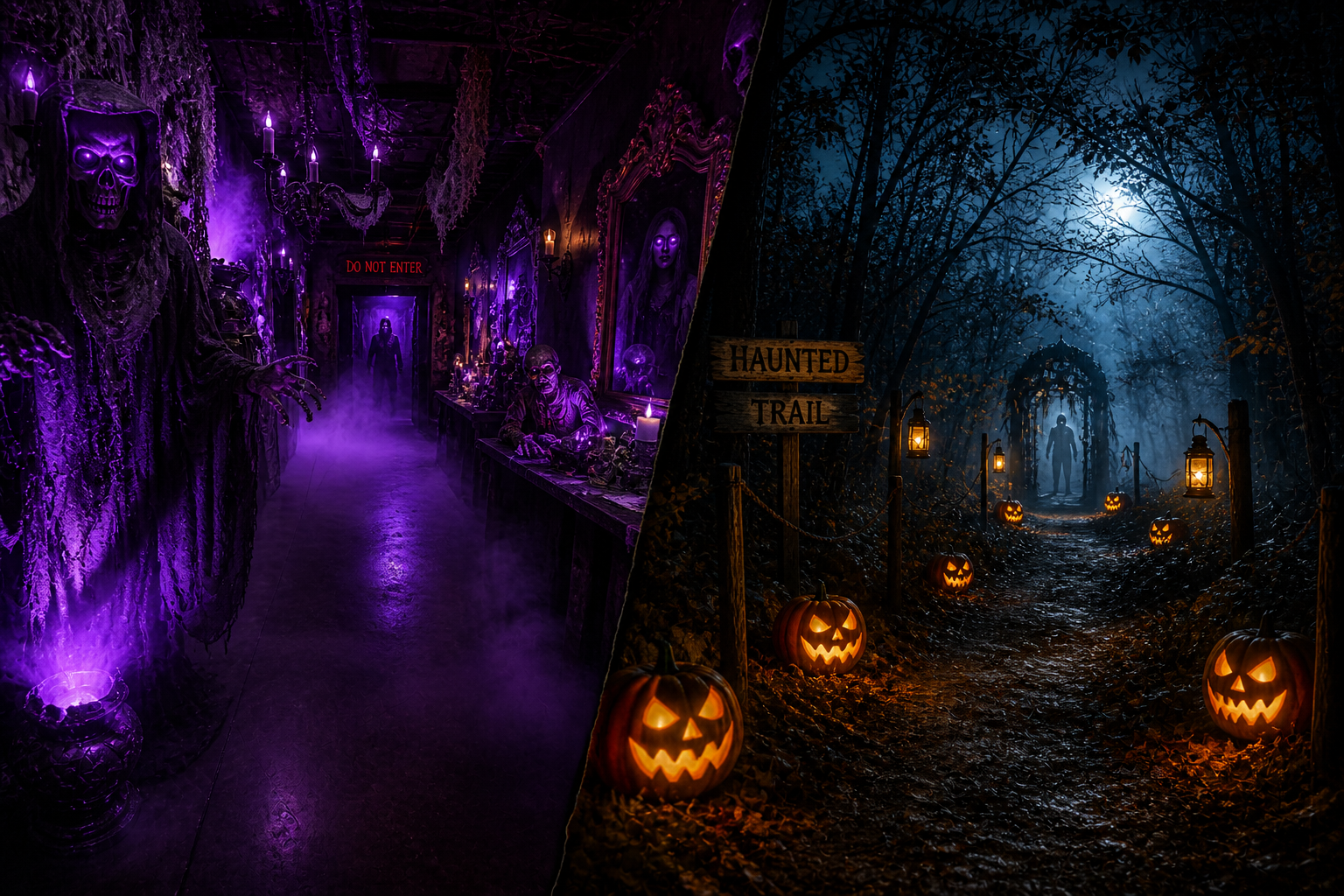
Indoor vs Outdoor Haunted Attractions: Pros, Cons, and How to Choose
Indoor haunted attractions offer controlled environments with elaborate theatrical staging, consistent scares regardless of weather, and immersive room-by-room storytelling. Outdoor haunted attractions—trails, hayrides, and scream parks—trade theatrical control for raw scale, natural atmosphere, and the primal discomfort of darkness in open space. Which is better depends on what kind of fear you’re chasing and how much weather uncertainty you’re willing to accept.
Every October, millions of haunted house visitors face a version of the same question: do I want the controlled, theatrical experience of an indoor haunt, or the sprawling, unpredictable atmosphere of an outdoor trail? The answer shapes everything—your wait times, your scare style, your footwear choices, and your willingness to check the weather forecast before you leave the house.
This guide breaks down both formats honestly. We cover the strengths, weaknesses, and ideal visitor profiles for each so you can spend less time wondering and more time getting scared.
What Is an Indoor Haunted Attraction?
Indoor haunted attractions are purpose-built or repurposed structures—warehouses, commercial spaces, multi-story buildings—transformed into walk-through experiences. Guests move through a sequence of themed rooms or corridors, each designed as a distinct scare environment. The Factory of Terror in Canton, Ohio holds a Guinness World Record as the world’s longest haunted house. Urban haunts like Thirteenth Floor Entertainment Group locations across the country demonstrate what’s possible when professional production budgets meet theatrical design.
The defining characteristic of indoor haunts is control. Lighting, sound, temperature, humidity, timing—everything is engineered. Scare actors know exactly when to trigger an effect. Jump scares are calibrated. The fog machine activates at the precise moment a guest rounds a corner. That level of craft produces experiences with consistent, high-density scare delivery.
What Is an Outdoor Haunted Attraction?
Outdoor haunted attractions include haunted trails through forests or cornfields, hayrides through scare zones, multi-acre scream parks with multiple outdoor sections, and hybrid attractions that combine indoor rooms with outdoor segments. Large-scale operations like Terror in the Corn (Iowa) span multiple acres. Haunted hayrides at attractions across New England and the Midwest have been a fall tradition for generations.
The defining characteristic of outdoor haunts is scale and atmosphere. A cornfield at night, with fog rolling across ankle height and a figure emerging from the stalks twenty feet ahead of you, creates a dread that no theatrical backdrop can fully replicate. Nature provides the atmospheric baseline; haunt operators amplify it.
Pros and Cons: Indoor Haunted Attractions
Pros
- Weather-proof: Rain, cold, and wind don’t affect your experience. Tickets are typically valid for any open night if a closure occurs.
- Theatrical density: Room-by-room design allows for elaborate set construction, professional lighting rigs, and synchronized audio.
- Consistent pacing: Group throughput is managed, reducing bottlenecks and dead time between scares.
- Accessibility: Most indoor attractions are easier to navigate for guests with mobility limitations.
Cons
- Crowd proximity: Tight corridors can feel claustrophobic in a non-horror way when groups stack up during peak nights.
- Predictability: Repeat visitors often learn the layout. The element of genuine spatial surprise diminishes.
- Scale limits: Even the largest indoor haunt is constrained by its footprint in a way an outdoor trail is not.
Pros and Cons: Outdoor Haunted Attractions
Pros
- Genuine atmosphere: Natural darkness, ambient sound, and open space produce a sensory experience impossible to fully replicate indoors.
- Scale: Outdoor attractions can span acres, with multiple distinct scare zones, hayride segments, and environmental variety.
- Surprise geometry: Trails and open terrain deny guests the ability to anticipate what’s coming around the next turn.
- Social experience: The shared discomfort of being outside in the dark with a group amplifies the communal scare experience.
Cons
- Weather dependency: Rain, extreme cold, or high winds can significantly degrade the experience or cause closures.
- Footwear and terrain: Mud, uneven ground, and low visibility require practical footwear—not the stylish Halloween costume boots you might prefer.
- Pacing gaps: Large outdoor trails can have dead zones between active scare sections, especially on slower nights with fewer actors deployed.
- Accessibility: Uneven terrain and outdoor environments are often difficult or impossible for guests with limited mobility.
Which Should You Choose?
Choose an indoor haunt if you want a high-density scare experience with theatrical polish, if weather uncertainty would ruin the night, or if you’re visiting with guests who have mobility limitations. Indoor haunts are also the better choice for groups that include anyone prone to genuine panic in uncontrolled outdoor environments.
Choose an outdoor haunt if you want scale, atmospheric immersion, and the primal experience of genuine darkness. If you’re a haunted attraction veteran who has “solved” indoor layouts and wants a format that can still genuinely disorient you, an outdoor trail or scream park delivers that. Dress for the weather, wear trail shoes, and embrace the unpredictability.
Many of the best haunted attractions in the country combine both: an outdoor hayride leading to an indoor warehouse section, or a multi-acre scream park with a mix of trail and indoor room experiences. These hybrid attractions offer the best of both formats and are worth seeking out on the Haunt Harvester directory.
Frequently Asked Questions
Are outdoor haunted attractions scarier than indoor ones?
It depends on the individual visitor. Outdoor attractions offer atmospheric immersion that can produce genuine, deep-seated fear—especially for guests sensitive to darkness and open spaces. Indoor haunts deliver higher-density jump scares with professional staging. Most experienced haunters would say the two types of fear are different, not ranked.
What should I wear to an outdoor haunted attraction?
Wear closed-toe shoes with good grip—trail runners or hiking boots are ideal. Dress in layers; outdoor haunts in October can get cold, especially on hayrides. Avoid costumes with long trailing elements that can catch on terrain or trip other guests.
Do outdoor haunted attractions close for rain?
Policies vary by attraction. Many outdoor haunts operate in light rain but close for lightning or severe weather. Check the attraction’s social media on the day of your visit and confirm the cancellation/refund policy before purchasing tickets.
Can kids attend outdoor haunted attractions?
Many outdoor scream parks and trails are designed for adult audiences and may not be appropriate for young children. Family-friendly outdoor options exist—haunted hayrides with moderate intensity are often suitable for older kids. Always check the attraction’s age recommendation before bringing children.
Find the best indoor and outdoor haunted attractions near you. Browse the Haunt Harvester Directory— one of the most active haunted house database in the country.
As an Amazon Associate we may earn commission from qualifying purchases at no extra cost to you.
new in halloween animatronics
Our honest Spirit Halloween Whirling Wendy review: a 360-degree counter-spinning clown we score 3.7/5. See if this photogenic 2026 centerpiece is worth it.
Spirit Halloween's Willow Witch is a 5 ft 9 in 2026 animatronic at $299.99 with industry-first conversation-response tech that listens and replies in real time.
Home Depot's 8 ft Perilous Plant Monster animatronic (2026) is a $299 outdoor Wicked Woods giant. See what it does, where to buy it, and if it is worth it.
Find Haunted Houses in:
trending in haunt industry
Everything you need to know about East Coast Haunters Convention 2026 — dates, location, what to expect, haunt tours, seminars, and how to get tickets before prices increase.
HalloweenCostumes.com's 2026 Fan Design Program lets you design a real Halloween animatronic. Two winners get 10 props each plus 5% revenue. Submissions close April 30.
ShudderCon 2026 runs April 25–26 at Camp Jordan Arena in East Ridge, TN. Tickets from $15–$75. Here's the full preview for horror fans, haunt pros, and scare actors.