

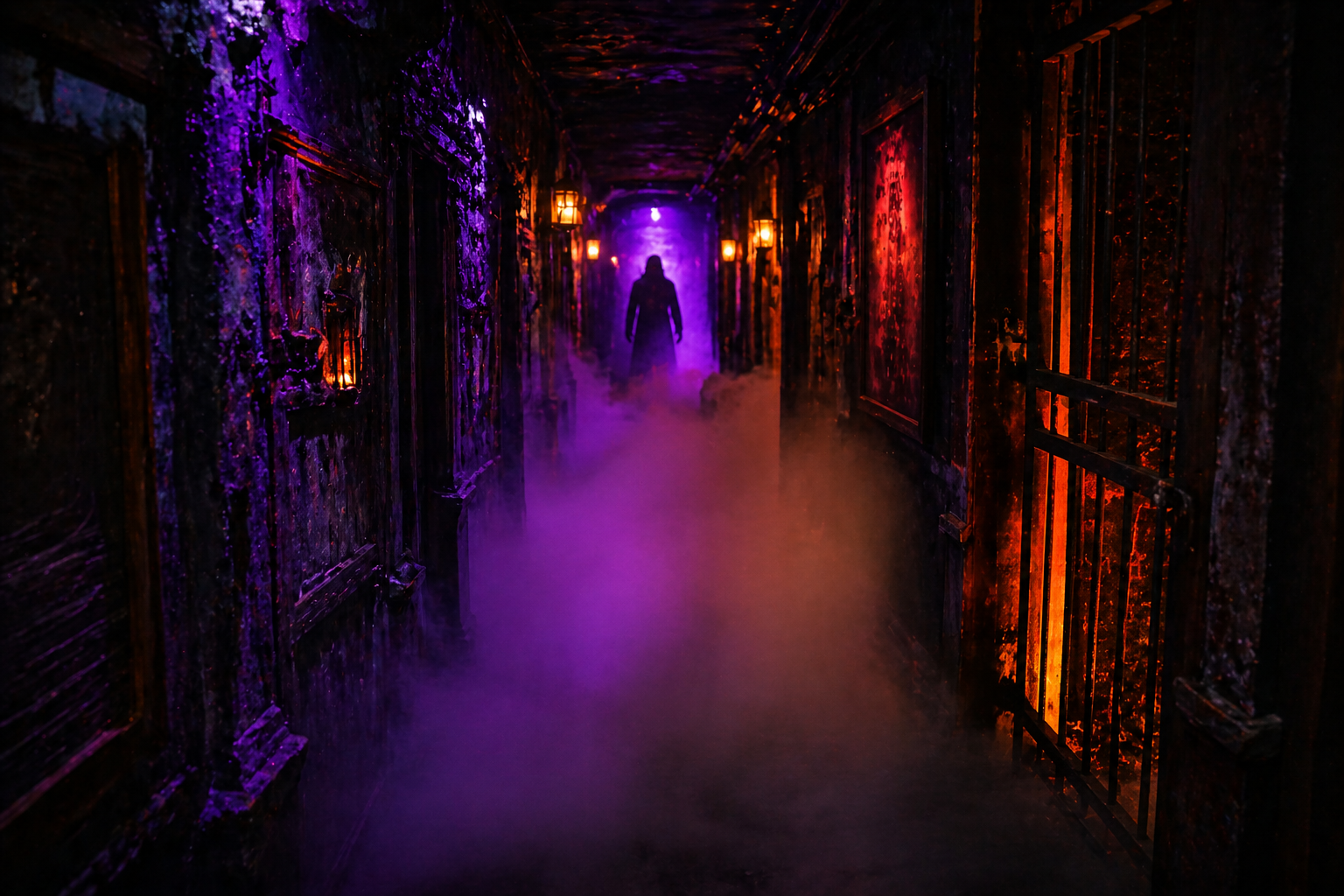
What Happens Inside a Haunted House? A Complete Visitor Guide
Inside a haunted house, visitors walk through a series of themed rooms and corridors designed to disorient, surprise, and terrify — using live scare actors, animatronics, fog, strobe lighting, sound effects, and immersive set design to trigger the body’s natural fight-or-flight response in a controlled, safe environment.
You’ve heard the screams coming from outside. You’ve watched people stagger out laughing, clutching each other, half-terrified and half-euphoric. But if you’ve never actually been inside a professional haunted house, the experience can seem mysterious — even intimidating. What actually happens in there? What should you expect? Is it safe?
This guide breaks down exactly what happens inside a haunted house, from the moment you enter to the second you stumble out the other side.
The Basic Structure: What a Haunted House Actually Is
A professional haunted house is essentially an elaborately designed maze. The attraction is divided into a series of themed rooms, corridors, and scenes, each with its own aesthetic, characters, and scare mechanisms. You move through the haunt in a roughly linear path, experiencing new environments every 30–60 seconds as you progress.
Most haunted houses are designed so you can’t anticipate what’s coming next. Walls are positioned to limit sightlines, turns are sharp and unexpected, and lighting is carefully controlled to create maximum disorientation. The goal of every design choice is to make you feel like you’ve entered a different world — one where danger could be lurking around any corner.
Scare Actors: The Human Element
Live scare actors are the backbone of professional haunted houses. These are trained performers — often with backgrounds in theater, improv, or stunt work — who portray monsters, murderers, ghosts, demons, and other characters throughout the attraction. They know how to read a group, time their appearances for maximum impact, and perform the same character dozens of times a night without losing effectiveness.
Scare actors use several key techniques: distraction and misdirection (a prop draws your attention one way while an actor appears from another direction); positional concealment (actors hiding in closets, under props, behind walls); jump scares (sudden appearances synchronized with audio cues); and ambient presence (moving slowly among visitors to create creeping dread rather than a direct scare).
One important note: at virtually every legitimate haunted attraction, scare actors follow a strict no-contact policy. Actors will not physically contact visitors, and visitors should not touch actors. This rule exists to protect both parties and ensure a safe experience for everyone.
Animatronics: The Mechanical Monsters
Modern haunted houses blend live performance with sophisticated mechanical props. Animatronics — motorized, programmable figures that move, vocalize, and react — serve multiple functions: they occupy positions that don’t need a live actor, provide consistent scares on a precise timer, and deliver visual spectacles that no human performance can replicate at scale.
High-end haunts feature 7-foot articulated monsters that lunge from the shadows, hydraulically powered creatures that drop from the ceiling, or photo-realistic figures nearly indistinguishable from actors until they move. The 2026 generation of professional animatronics includes sensor-triggered activation — the prop doesn’t move until you’re in its optimal scare zone — maximizing effectiveness while minimizing mechanical wear.
The Technology: Fog, Sound, Lighting, and Scent
The environmental effects in a professional haunted house do as much psychological work as the actors and animatronics. Each element is calibrated to amplify the core fear response.
Fog and Atmospheric Haze
Fog machines and haze generators fill rooms with atmospheric mist that serves two purposes: it obscures sightlines (you can’t see what’s lurking at the far end of the corridor) and it makes every light source more visually dramatic. Haunts use both dense “chiller fog” that rolls along the floor and fine atmospheric haze that fills entire rooms.
Sound Design
The audio environment inside a professional haunt is meticulously designed. Each room has its own soundscape — industrial machinery, whispered voices, dripping water, horror soundtrack stings, screams from deeper in the building. Sound is used to build anticipation and to cover auditory cues that would reveal actor positions. Some high-end haunts use directional speaker systems that place sounds precisely in 3D space around you.
Lighting Effects
Strobe lights, blacklights, flickering incandescent bulbs, colored washes, and total blackout sections are all standard tools in a haunted house lighting designer’s kit. Strobe lights fragment visual continuity — you see the room in snapshots rather than a smooth visual stream, making movement difficult to track. Blackout sections force visitors to move through complete darkness, removing visual anchoring entirely.
Scent Effects
Premium haunts increasingly use scent as an environmental layer — the smell of decay in a morgue room, burning wood in a fire scene, earth and mold in a graveyard corridor. Scent triggers emotional memory more directly than any other sense, and a well-chosen scent deepens immersion dramatically.
Themes and Room Types You’ll Encounter
While every haunted house is unique, certain theme environments appear consistently: haunted cemetery or graveyard scenes with fog-covered tombstones and skeletal actors; asylum or hospital rooms with clinical lighting and medical horror props; haunted manor or Victorian interior scenes with gothic set dressing; slaughterhouse or industrial environments with visceral prop work; clown and carnival rooms with disorienting geometry and blacklights; and outdoor woodland passages with natural environments and full-darkness sections.
The Science of Why It Feels So Good
Here’s the surprising part about haunted houses: being scared is physically enjoyable. When your brain triggers the fight-or-flight response in a haunt, your adrenal glands release adrenaline, your heart rate increases, your senses sharpen, and your body floods with endorphins and dopamine — the same neurochemicals released during intense exercise or other pleasurable activities.
Because your rational mind knows you’re in a safe, controlled environment, the fear signal never escalates to genuine distress. Instead, it delivers a sustained burst of excitement. The more surprising and unpredictable the experience, the more dopamine is released — which is exactly why great haunts invest so heavily in the element of surprise.
Frequently Asked Questions
Will the actors touch me inside a haunted house?
At virtually all professional haunted attractions, a strict no-contact policy exists between actors and visitors. Actors are trained to scare without physical contact. Some specialized “extreme” haunts offer opt-in contact experiences for adult audiences who explicitly consent — but these are the exception, not the rule.
Is it safe to go to a haunted house?
Yes. Professional haunted houses are designed with visitor safety as a fundamental constraint. Exit routes are clearly marked, actors are trained in safety protocols, and the effects used are non-harmful. Strobe lights may be an issue for visitors with photosensitive epilepsy — look for warnings posted at the entrance.
What should I wear to a haunted house?
Comfortable, closed-toe shoes are essential — you’ll be walking on uneven surfaces in low light. Avoid long skirts or capes that could catch on props. Dress in layers if you’ll be waiting outdoors.
Can I go through a haunted house alone?
Yes, and some veterans argue going alone is the most intense way to experience a haunted house — there’s no one behind you to absorb scares, and actors often prioritize the person at the front of the group. Groups of 3–5 are the most common and generally enjoyable configuration.
Ready to find a haunted house near you? Search the HauntHarvester Directory — the most comprehensive guide to haunted attractions across the United States, with fear level ratings, visitor reviews, and ticket links for every haunt in our database.
new in halloween animatronics
Our honest Spirit Halloween 5 Ft 8 In Valak (The Nun) animatronic review: a $325.99 officially licensed lunging demon nun scored 4.0 out of 5 for scare.
Our honest Spirit Halloween LED Red and Black Jumping Spider review: a $49.99 motion-activated jump prop with light-up eyes, scored 3.3 out of 5 on value.
Home Depot's 12 ft Skelly sells out fast every year. See when it restocks in 2026, the $299 price, and how to buy the giant skeleton before it is gone.

Paid link: As an Amazon Associate we may earn commission from qualifying purchases at no extra cost to you.
Find Haunted Houses in:
trending in haunt industry
Everything you need to know about East Coast Haunters Convention 2026 — dates, location, what to expect, haunt tours, seminars, and how to get tickets before prices increase.
HalloweenCostumes.com's 2026 Fan Design Program lets you design a real Halloween animatronic. Two winners get 10 props each plus 5% revenue. Submissions close April 30.
ShudderCon 2026 runs April 25–26 at Camp Jordan Arena in East Ridge, TN. Tickets from $15–$75. Here's the full preview for horror fans, haunt pros, and scare actors.