

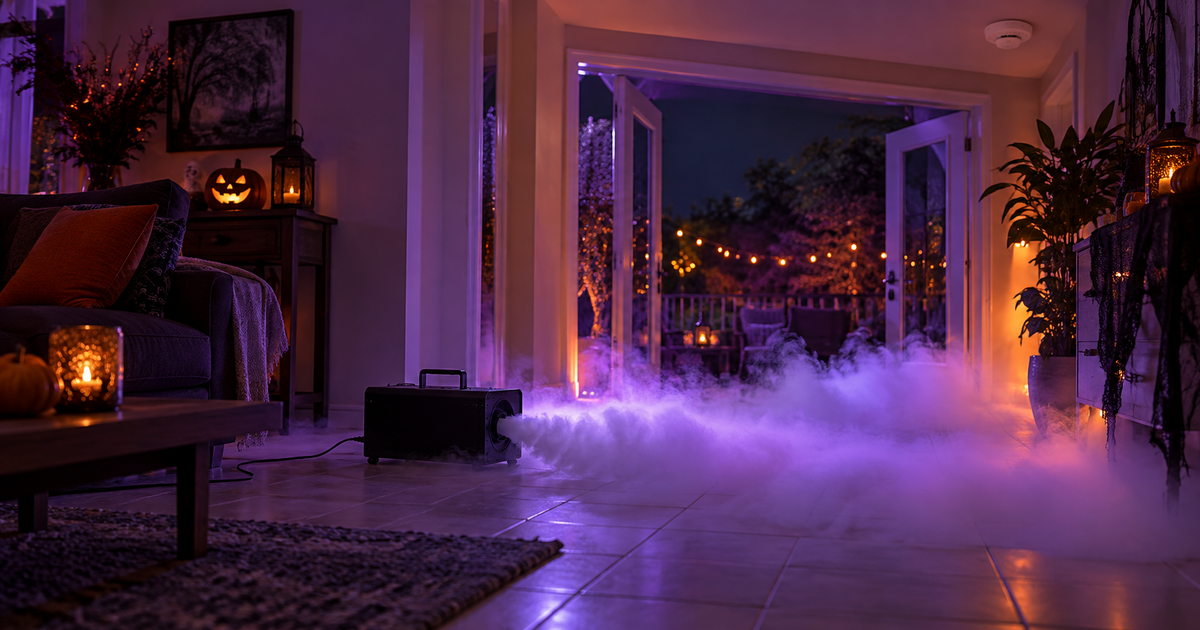
Will a Fog Machine Set Off Smoke Detectors? How to Fog Safely Indoors
Yes, a fog machine can set off a smoke detector. Fog is a dense cloud of tiny droplets, and most smoke alarms cannot tell those droplets from smoke, so a big burst that drifts into a detector can trigger it. Chauvet, one of the biggest fog-machine makers, states plainly that all fog and haze machines may set off smoke detectors depending on how much fog you make. The fix is not to disable your alarms — it is to fog outdoors, use short bursts, keep the cloud low and away from detectors, and ventilate.
Fog is the cheapest way to make a Halloween scene feel alive, and it is the number one question we hear from people planning an indoor party or a garage haunt: will this thing set off the alarms? The short answer is that it can. The longer answer is that it is very manageable once you understand why it happens. This guide covers why fog trips detectors, which setups are most at risk, and how to fog safely — without ever covering or switching off the smoke alarms that protect your home. If you are still choosing a machine, start with our guide to the best fog machines for Halloween and home haunts.
Why does a fog machine set off smoke detectors?
A standard fog machine heats water-based fog fluid until it flashes into vapor. When that vapor hits cooler air, it condenses into a thick white cloud of tiny droplets. Smoke detectors are built to react to particles in the air, and a dense fog cloud is exactly that. The detector cannot tell whether those particles came from a burning couch or a fog machine, so if enough fog reaches the sensor, it alarms.
There are two common household detector types, and fog can fool both:
| Detector type | How it senses | How fog affects it |
|---|---|---|
| Ionization | Detects a change in a tiny electrical current when particles enter the chamber | Widely reported by theater and venue crews as especially prone to nuisance alarms from fog |
| Photoelectric | Detects particles that scatter or block a light beam inside the chamber | A drift of dense fog into the chamber can scatter the beam and trigger it |
| Combination | Uses both methods | Can alarm from either sensor |
| Heat detector (some garages/kitchens) | Reacts to temperature, not particles | Fog alone is generally not what trips it |
Density is the whole game. A thin haze drifting across a room is far less likely to reach alarm level than a thick cloud billowing straight up at the ceiling, which is exactly where detectors are mounted.
Is it safe to use a fog machine indoors?
Many people do use fog indoors for parties and haunts, but treat it with the same care you would any heated appliance. Chauvet’s own caution sheet lists three things worth knowing: fog machines should sit on a non-flammable surface such as concrete or tile (never carpet or fabric), fog may set off smoke detectors, and fluid-based fog can leave a slippery residue on floors in some settings. Use only the fluid made for your machine — theater-effects suppliers warn that adding dye, scent, or anything else to fog fluid can damage the machine and may produce harmful fumes. Our fog juice guide explains which fluid does what.
If anyone in your group has asthma or other breathing sensitivities, ask first and keep the fog light, or keep it outside. When in doubt, go lighter.
Never disable, cover, or bag a smoke detector to run fog. A detector that is off during a party is a detector that is off during a real fire. If your alarm system is hardwired or professionally monitored, a false alarm may also dispatch the fire department — check with your alarm company before fogging near monitored sensors. Venues (schools, halls, rented spaces) set their own rules; ask the building manager or local fire officials, and follow what they say.
How do you use fog without setting off the alarm?
These habits keep fog where you want it and away from the ceiling:
- Fog outdoors whenever you can. A front-yard scene or open porch almost never has a detector nearby, and the open air carries fog away before it builds up.
- Use short bursts, not a constant stream. A few seconds of fog every minute or two looks better and keeps density down. A programmable outdoor timer or your machine’s remote makes timed bursts easy.
- Keep the cloud low. Warm fog rises toward detectors; chilled fog hugs the floor. Our guide to getting low-lying ground fog shows how to chill it so it stays at ankle height.
- Aim away from detectors. Point the nozzle along the floor or toward an open door, never up at the ceiling or toward a hallway alarm.
- Ventilate. A cracked window or a fan pulling air out of the room keeps fog from pooling and slowly climbing to the ceiling.
- Test before guests arrive. Run a short burst with the room set up the way it will be during the party and watch where the fog drifts.
Which fog fluid and machine are least likely to trip alarms?
No fluid or machine is “detector-proof” — any fog dense enough to see can reach alarm level. But your choices change how quickly fog builds up and how long it hangs. A modest-output machine run in bursts is easier to control indoors than a big high-output fogger. A popular all-purpose starting point is the Chauvet DJ Hurricane 700 fog machine; pair it with a quality water-based fluid such as Froggy’s Fog Swamp Juice. Long-hang, high-density fluids like Froggy’s Freezin’ Fog are great outdoors and in chilled low-fog rigs, but they linger longer indoors, so use them sparingly inside. Read the label and the machine manual — they are the final word for your specific model.
For the full setup routine, including warm-up, placement, cleaning, and storage, see our step-by-step guide on how to use a fog machine.
What should you do if the fog sets off the alarm?
- Turn off the fog machine first so you are not adding more fog.
- Check that there is no actual fire or burning smell. Never assume it is “just the fog.”
- Open doors and windows and run a fan to clear the air near the detector.
- Use the detector’s hush or silence button if it has one — do not pull the battery or unplug it.
- If your system is monitored, call your alarm company right away so they know it was a false alarm.
- Once the air clears, move the machine, shorten the bursts, and try again.
Frequently Asked Questions
Will a fog machine set off a smoke detector? It can. Fog is a dense cloud of tiny droplets, and both ionization and photoelectric smoke detectors can mistake it for smoke if enough reaches the sensor. Chauvet notes that all fog and haze machines may set off detectors depending on fog output.
Will a fog machine set off a carbon monoxide detector? Carbon monoxide detectors sense CO gas, not particles, and a water-based fog machine is not designed to produce CO. Many homes use combination smoke/CO units, though, and the smoke sensor in those can still react to fog.
Can I cover my smoke detector while I use fog? No. Covering or disabling a detector leaves your home unprotected, and it is exactly when people forget to uncover it afterward. Fog outdoors, use short bursts, keep it low, and ventilate instead.
Is fog machine smoke harmful? Water-based fog from a machine run with the correct fluid is widely used at haunts and events, but it can irritate some people, especially those with breathing sensitivities. Keep fog light indoors, ventilate, never add anything to the fluid, and ask guests before you fog.
Does low-lying fog set off smoke detectors? Chilled low-lying fog stays near the floor, far from ceiling-mounted detectors, so it is much less likely to trip them. As it warms it can rise, so ventilation still matters.
Ready to pick a machine that fits your space? Compare the best fog machines and fog your haunt the smart way.

As an Amazon Associate we may earn commission from qualifying purchases at no extra cost to you.
new in halloween animatronics
Our honest Spirit Halloween Mr. Dark review: a black-robed skeleton that pops up to nearly nine feet on a scissor lift for $370.99. We score it 3.9 of 5.
Our honest Spirit Halloween Electrified Corpse review: a wire-wrapped torso that violently shakes and screams overhead for $149.99. We score it 3.4 of 5.
Our honest Spirit Halloween Wind-Up Wally review: a creepy wind-up clown with a 360-degree spinning key and a pop-up scare for $185.99. We score it 3.5 of 5.
Find Haunted Houses in:
trending in haunt industry
Everything you need to know about East Coast Haunters Convention 2026 — dates, location, what to expect, haunt tours, seminars, and how to get tickets before prices increase.
HalloweenCostumes.com's 2026 Fan Design Program lets you design a real Halloween animatronic. Two winners get 10 props each plus 5% revenue. Submissions close April 30.
ShudderCon 2026 runs April 25–26 at Camp Jordan Arena in East Ridge, TN. Tickets from $15–$75. Here's the full preview for horror fans, haunt pros, and scare actors.