

Best Remote Controls for Halloween Animatronics and Props (2026)
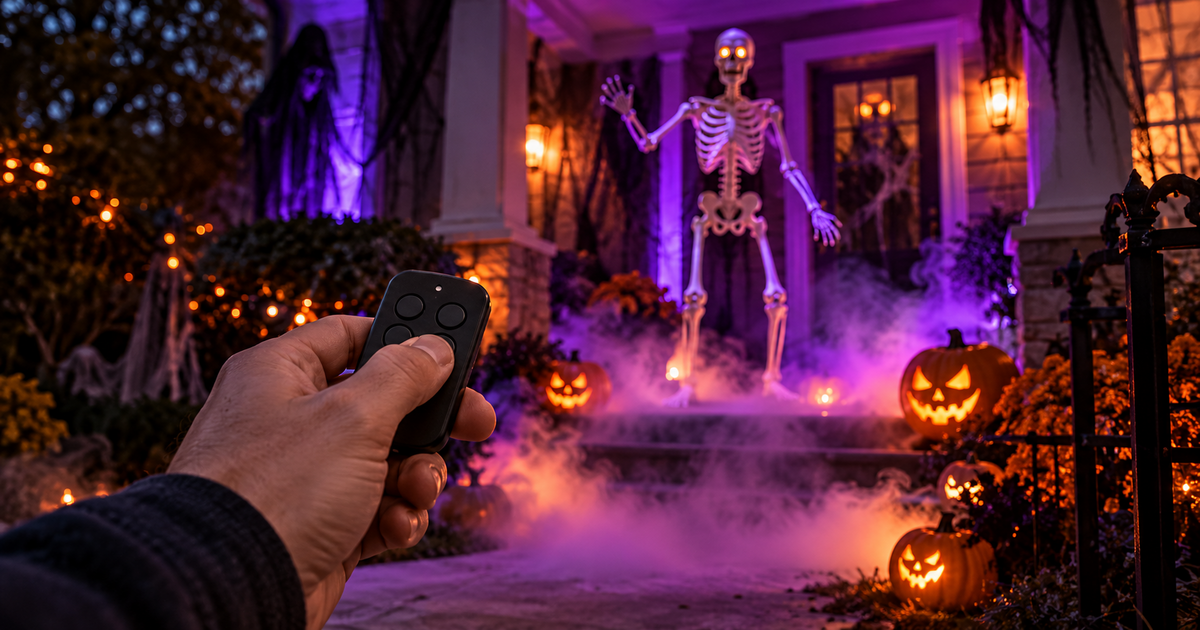
A remote control outlet lets you fire a Halloween prop, fog machine, or light on cue from a hidden spot instead of waiting for a motion sensor to do it automatically — most home haunt setups use a simple RF (radio frequency) remote outlet with a 100–200 foot range, and outdoor displays need one rated specifically for weatherproof or damp-location use.
Haunt Harvester is reader-supported and may earn a commission from qualifying purchases made through links on this page, at no extra cost to you. We only feature products we would tell a friend about.
If you have ever wanted to jump-scare trick-or-treaters at exactly the right moment instead of hoping a motion sensor catches them at the right distance, a weatherproof remote control outlet is the simplest way to do it — plug your prop, light, or fog machine into the receiver, keep the transmitter in your pocket or hidden nearby, and press the button whenever a guest walks into position. It is the same basic trick professional haunts use with expensive show-control systems, just scaled down to a $20–$30 outlet anyone can set up in five minutes.
How do remote control outlets work for Halloween props?
Most remote control outlets pair a small RF transmitter (the handheld remote) with a receiver that plugs into the wall; your prop, light, or machine plugs into the receiver. Press the button and the receiver switches power on or off — there is no app, no Wi-Fi setup, and no line-of-sight requirement the way an infrared remote would need. RF signals pass through walls and around corners, which is exactly why they work well for a haunter hiding behind a fence or inside a garage while triggering a prop out at the curb.
RF remote vs. smart plug — which do home haunters actually use?
An RF remote is the simpler, more reliable choice for a live jump-scare trigger, because pressing a physical button is instant and does not depend on a Wi-Fi connection holding up in your yard. A Wi-Fi smart plug is better suited to scheduling — turning your whole display on at dusk and off at a set time — than to a hand-timed scare, since there is usually a short delay between tapping a phone app and the plug actually switching. Many home haunters run both: smart plugs on the ambient lighting and fog on a timer, RF remotes on the one or two props they want to fire themselves.
What should you look for in a remote control outlet?
| Remote outlet type | Best for | Typical price |
|---|---|---|
| Weatherproof outdoor remote outlet | Yard displays and porch setups exposed to rain or dew | $25–$35 |
| Indoor wireless remote outlet | Garage haunts, indoor scenes, or props kept under a covered porch | $20–$28 |
| Multi-outlet remote kit (3–5 receivers) | Triggering several props or light zones from one remote | $25–$45 |
| Wi-Fi smart plug | Scheduling ambient lights or fog to turn on automatically at dusk | $10–$20 |
Range matters more than most first-time buyers expect: a listing that advertises 100 feet of range is measuring open-air, line-of-sight distance, so a fence, a parked car, or the corner of your house can cut real-world range noticeably. If you plan to trigger a prop from well inside the house while guests approach the street, look for a unit advertising 150 feet or more of rated range and test it at your actual hiding spot before Halloween night.
How do you set up a remote control outlet for a prop?
- Confirm the wattage. Add up everything you plan to plug into one receiver and check it against the outlet’s rated load (commonly 1,000–1,875W) before wiring anything.
- Pair the remote to the receiver. Most units ship pre-paired out of the box; if you buy a multi-receiver kit, follow the included pairing sequence (usually holding a button on the receiver while pressing the remote) so each receiver only responds to its assigned button.
- Position the receiver at the prop, not at your hiding spot. The receiver plugs in wherever your prop or light lives; you keep the transmitter with you.
- Test your actual triggering position before Halloween night. Stand exactly where you plan to hide and press the button — walls, fences, and metal siding can all knock down RF range, and it is much better to discover that a week early than mid-scare.
- Label each remote button if you are running more than one receiver. A strip of tape and a marker saves you from fumbling for the right button while a group of trick-or-treaters is already walking up.
Outdoor and load safety: only use a receiver rated for outdoor or damp-location use if it will be exposed to weather, plug it into a GFCI-protected outlet, and never exceed the printed wattage rating — that applies whether you are running one prop or splitting several off a multi-outlet kit. If you are combining a remote-triggered prop with fog or extra lighting on the same circuit, our home haunt lighting guide and our fog machine buying guide both cover safe circuit planning in more detail.
Remote control or motion sensor — do you need both?
A remote control outlet puts you in charge of exactly when a prop fires, which is what you want for the one big scare you plan to time yourself from a hidden spot. A motion sensor is better for props you want to react automatically when nobody is manning the trigger — a walkway skeleton, a porch light, a background fog burst. Most home haunts end up using both: a couple of motion-triggered ambient props near the street, and one or two remote-triggered scares reserved for the moment a group actually reaches the door.
Frequently Asked Questions
How far will a remote control outlet actually work? The advertised range (often 100–200 feet) is measured in open air with a clear line of sight; walls, fences, and metal siding will cut that down, so test from your real hiding spot before relying on it.
Can I use a remote control outlet outside in the rain? Only if the receiver is specifically listed as outdoor or weatherproof rated, plugged into a GFCI-protected outlet, and kept off the ground.
How many props can one remote control at once? A single remote and receiver typically controls one outlet; multi-outlet kits pair one remote with 3–5 separate receivers so you can fire (or leave silent) each prop independently.
Do I need a smart plug or a plain RF remote? An RF remote is the better choice for an instant, hand-timed jump scare; a Wi-Fi smart plug is better for scheduling ambient lights or fog to switch on automatically at a set time.
Will a metal fence or my house wall block the signal? It can reduce range significantly. If your hiding spot is behind a solid wall or fence, test the actual range you will use on the night rather than trusting the box’s advertised distance.
Ready to plan your full display? Start with our home haunt beginner’s guide.

As an Amazon Associate we may earn commission from qualifying purchases at no extra cost to you.
new in halloween animatronics
Home Depot's 11 ft Giant Mummy animatronic (2026) is a poseable under-$300 yard giant. See its specs, price, where to buy it, and whether it is worth it.
Spirit Halloween's Trash Bandit is a 3 ft 7 in radioactive-raccoon animatronic for 2026 at $149.99, with a pop-up scare, growls, and glowing blacklight decay.
Home Depot's John the Last Call Mixologist is a 6 ft animated bar skeleton for 2026 at about $179. See what it does, where to buy it, and if it is worth it.
Find Haunted Houses in:
trending in haunt industry
Everything you need to know about East Coast Haunters Convention 2026 — dates, location, what to expect, haunt tours, seminars, and how to get tickets before prices increase.
HalloweenCostumes.com's 2026 Fan Design Program lets you design a real Halloween animatronic. Two winners get 10 props each plus 5% revenue. Submissions close April 30.
ShudderCon 2026 runs April 25–26 at Camp Jordan Arena in East Ridge, TN. Tickets from $15–$75. Here's the full preview for horror fans, haunt pros, and scare actors.