

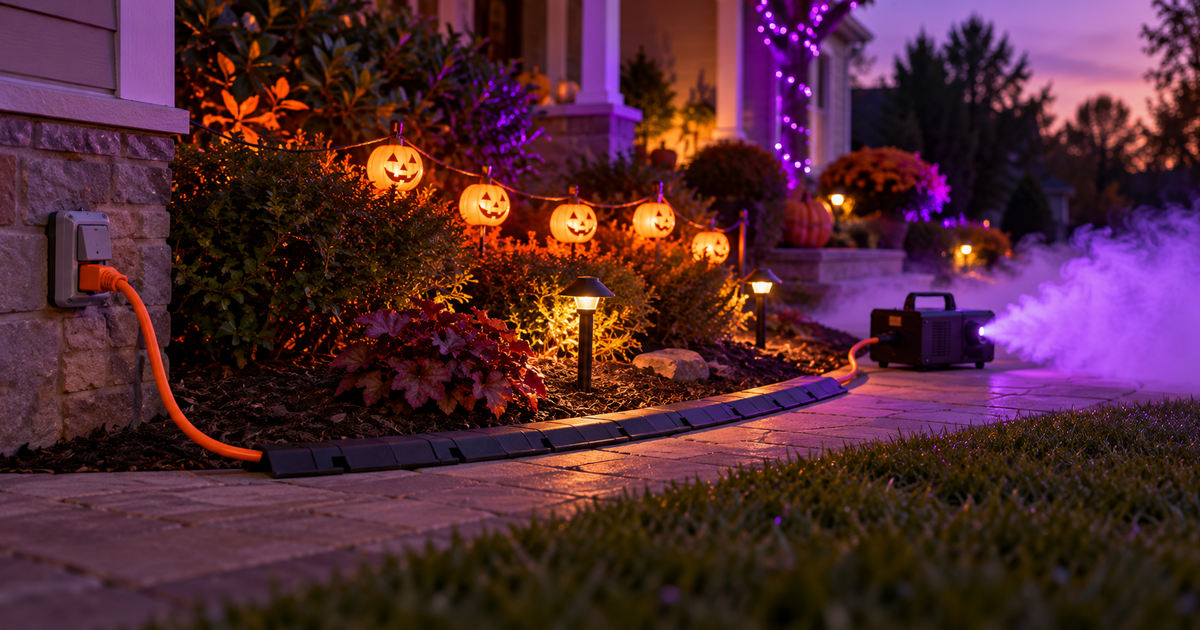
Halloween Extension Cord and Outdoor Power Safety: Cord Gauge, GFCI, and Timers
Power your Halloween display with an outdoor-rated extension cord sized for the load (a 16-gauge cord handles a strand of lights; a fog machine or several animatronics needs 14- or 12-gauge), plugged into a GFCI-protected outlet, and never daisy-chained cord to cord. Add a smart plug or mechanical timer so your display shuts off automatically instead of running all night unattended.
Haunt Harvester is reader-supported and may earn a commission from qualifying purchases made through links on this page, at no extra cost to you. We only feature products we would tell a friend about.
Every fog machine, animatronic, and string of lights in your yard eventually traces back to one extension cord, and that cord is the part most home haunters think about least. A 16/3-gauge outdoor extension cord covers most single-prop setups, but bigger displays need a heavier gauge and a plan for weatherproofing and timing — both covered below.
What gauge extension cord do you need?
Cord gauge is a wire-thickness rating, and counterintuitively, the smaller the number, the thicker the wire and the more current it can carry safely. Longer cords and heavier loads both call for a thicker (lower-numbered) gauge.
| Cord length | 16-gauge handles | 14-gauge handles | 12-gauge handles |
|---|---|---|---|
| 25–50 ft | Up to 13 amps | 14–15 amps | 16–20 amps |
| 100 ft | Up to 10 amps | 11–13 amps | 14–15 amps |
| 150 ft | Not recommended | Up to 7 amps | 8–10 amps |
A single string of LED lights or one small animatronic draws well under 5 amps, so a basic 16-gauge cord is plenty. Add a fog machine, a full-size animatronic with a motor, and a few spotlights on the same run, and you are safer stepping up to 14- or 12-gauge — or better, splitting the load across two separate circuits instead of one long cord carrying everything.
What actually makes a cord “outdoor-rated”?
Outdoor-rated cords use a heavier, weather-resistant jacket (often marked W or WA on the cord itself) that holds up to moisture, UV exposure, and cold better than an indoor-only cord, and they are typically rated for a wider temperature range. Indoor extension cords are not built for ground contact, rain, or dew, and using one outdoors is a common and avoidable source of shorts and shock hazards. Check the cord’s jacket markings before you buy, or start with one built for it, like the PLUGTUL 25-ft outdoor extension cord (16/3 gauge, roughly $17), which is sized right for a single prop or a light run.
Do you need a GFCI outlet for Halloween lighting?
Yes, for anything outdoors. A ground-fault circuit interrupter (GFCI) outlet cuts power in a fraction of a second if it detects current leaking somewhere it shouldn’t — through water, through a person — which is exactly the scenario a rain-damp Halloween yard creates. Most homes built or rewired in the last couple of decades already have GFCI outlets on exterior circuits; if yours does not, a portable GFCI adapter that sits between the outlet and your cord is an inexpensive way to add that protection to any outdoor run.
How do you avoid overloading a circuit?
- Don’t daisy-chain cords. Plugging one extension cord into another to reach farther adds resistance and heat at every connection point; run a single cord of the right length instead.
- Don’t chain power strips. A multi-outlet strip should plug directly into a wall or GFCI outlet, never into another strip or cord.
- Spread heavy loads across circuits. If your fog machine, biggest animatronic, and spotlights would all land on one cord, split them across two separate outlets or circuits instead.
- Check for heat. A cord or connection that feels warm to the touch is carrying more than it should — unplug something and redistribute the load.
Before you plug anything in: inspect every cord for cracks, fraying, or exposed wire before each use — a damaged cord gets replaced, not taped over. Keep connections up off wet grass on a brick, box, or cord-cover rather than sitting in a puddle, and never run a cord under a rug, doormat, or through standing water. If a cord or plug feels warm, unplug it and reduce the load.
Should you put your display on a timer?
A mechanical or smart outdoor timer does two things: it turns your display on automatically at dusk so you never forget, and it shuts everything off at a set time instead of running all night unattended, which is both safer and easier on your electric bill. An outdoor programmable timer outlet plugs in between your GFCI outlet and your extension cord, so the whole display — lights, fog, animatronics — comes on and off together on one schedule. If you are wiring up a fog machine specifically, our best fog machines guide covers power draw by model, and our home haunt lighting guide walks through planning power runs for a full lighting layout.
Frequently Asked Questions
Can I use an indoor extension cord outside for one night? It is not recommended even briefly — indoor cords lack the weatherproof jacket and cold-weather rating that keep an outdoor cord safe from moisture and temperature swings, and the cost difference is small.
How many amps does a fog machine draw? It varies by model, generally in the 5–10 amp range for consumer machines — check your specific unit’s rating and avoid stacking it on the same cord as several other high-draw props.
Is it safe to run extension cords through wet grass? Keep connections elevated off wet ground where you can — a cord cover, brick, or small stand keeps plugs out of puddles and reduces shock and short-circuit risk.
What’s the difference between a smart plug and a mechanical timer? A mechanical timer runs on a simple clock dial and needs no app or Wi-Fi; a smart plug adds phone-app control and can adjust automatically for sunset time, at a slightly higher cost.
Do I need a GFCI outlet if I’m only running one small prop? Yes — GFCI protection matters most exactly when moisture is involved, which is every outdoor Halloween display regardless of how small the load is.
Powering a bigger build? See our full home haunt planning guide.

As an Amazon Associate we may earn commission from qualifying purchases at no extra cost to you.
new in halloween animatronics
Our honest Spirit Halloween Whirling Wendy review: a 360-degree counter-spinning clown we score 3.7/5. See if this photogenic 2026 centerpiece is worth it.
Spirit Halloween's Willow Witch is a 5 ft 9 in 2026 animatronic at $299.99 with industry-first conversation-response tech that listens and replies in real time.
Home Depot's 8 ft Perilous Plant Monster animatronic (2026) is a $299 outdoor Wicked Woods giant. See what it does, where to buy it, and if it is worth it.
Find Haunted Houses in:
trending in haunt industry
Everything you need to know about East Coast Haunters Convention 2026 — dates, location, what to expect, haunt tours, seminars, and how to get tickets before prices increase.
HalloweenCostumes.com's 2026 Fan Design Program lets you design a real Halloween animatronic. Two winners get 10 props each plus 5% revenue. Submissions close April 30.
ShudderCon 2026 runs April 25–26 at Camp Jordan Arena in East Ridge, TN. Tickets from $15–$75. Here's the full preview for horror fans, haunt pros, and scare actors.