

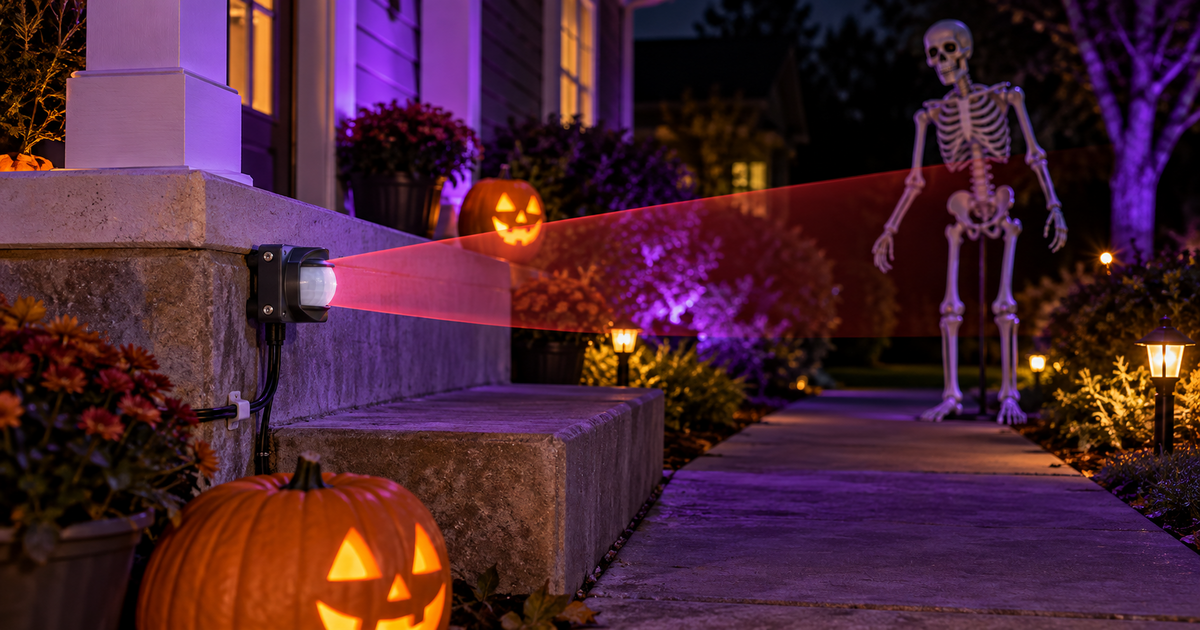
How to Add a Motion Sensor (PIR) to Trigger Your Halloween Props
A motion sensor plug uses a PIR (passive infrared) sensor to detect body heat moving across its field of view, then switches power to whatever is plugged into it — a light, a fog machine, or a low-draw animatronic — so the prop only fires when someone actually walks up. Most plug-in units are rated for a specific wattage (often 800–1,100W), so the trick is matching the sensor to the load and aiming it across the approach path instead of at open air.
Haunt Harvester is reader-supported and may earn a commission from qualifying purchases made through links on this page, at no extra cost to you. We only feature products we would tell a friend about.
The cheapest way to add a jump-scare trigger to a static Halloween prop is a plug-in PIR motion sensor outlet — no wiring, no soldering, just plug the sensor into the wall and your prop into the sensor. It is the same trick haunted attractions use on a much bigger budget: a prop that sits dark and silent until a guest crosses an invisible line, then suddenly lights up or moves. Get the placement and wattage right and a fifteen-dollar sensor can make a static skeleton feel like it is actually watching the walkway.
How does a PIR motion sensor actually work?
PIR stands for passive infrared — the sensor does not send out a beam like a laser trip-wire, it passively watches for changes in infrared (heat) radiation across its lens. A person walking through the sensor’s field of view changes the infrared pattern it sees, and that change is what triggers the switch. Most consumer PIR modules have an effective range of roughly 10 feet before the heat signature is too faint to register reliably, and many need a short calibration window — often 10–15 seconds of no motion right after power-up — before they start reading accurately.
Why sensors sometimes trigger for no reason
False triggers almost always come down to what is moving in the sensor’s field of view besides your visitors: a tree branch swaying in the wind, a car passing on the street, even a sudden gust that shifts a nearby decoration. Aiming the sensor down a walkway rather than out toward the road, and keeping the sensitivity dial on the lower setting for a tight yard, clears up most of it.
What can you actually trigger with a plug-in motion sensor?
A plug-in sensor is a simple on/off switch for whatever load you plug into it, so it is a great match for a corded light, a fog machine, a sound module, or a small motor — anything within the sensor’s rated wattage. It is the wrong tool for triggering a battery-powered animatronic that already has its own built-in motion sensor (most Spirit Halloween and Home Depot animatronics do), and it is not a substitute for a dedicated prop controller if you need multiple props to fire in a specific sequence.
| Sensor type | Best for | Typical price |
|---|---|---|
| Plug-in PIR motion sensor outlet | Turning a single light, fog machine, or small prop on when someone walks up — no wiring required | $14–$26 |
| Plug-in motion-activated light control | A classic, widely-used version built specifically for porch and yard lights | $20–$25 |
| Hardwired motion-sensor security spotlight | Lighting up an entire yard zone or driveway, not just one prop | $25–$50 |
| Bare PIR sensor module | Home haunters building a custom prop controller from scratch | $6–$15 |
How do you set up a motion sensor plug for a Halloween prop?
- Check the wattage first. Add up the wattage of whatever you are plugging in and confirm it is under the sensor’s rated load (commonly 800–1,100W for compact plug-in units) — a fog machine or a corded light is almost always fine; several high-draw items daisy-chained together may not be.
- Plug the sensor into the outlet, then your prop into the sensor. Most units have a photocell override so you can set them to only arm after dark, which keeps daytime dog-walkers from setting off your prop.
- Mount it at chest-to-waist height, angled across the walkway. Aim it so a person has to cross the beam to get to your front door or display, not so it is staring down the middle of the street.
- Set the sensitivity and time-delay dials. Start with a shorter delay (a few seconds) so the prop resets quickly for the next trick-or-treater, and dial sensitivity down if leaves or traffic keep setting it off.
- Test it after dark, at the actual distance guests will approach from. Daytime testing is unreliable because bright ambient heat and sunlight can mask the infrared signature the sensor is looking for.
Wattage and weather: never exceed the sensor’s printed wattage rating — overloading a motion sensor outlet is a fire risk, not just a blown fuse. If the sensor and prop will be outdoors, confirm the unit is rated for outdoor or damp-location use, plug it into a GFCI-protected outlet, and keep the connection off the ground. Our home haunt lighting guide covers safe outdoor wiring in more depth if you are running several sensors and props off one circuit.
Motion sensor or handheld remote — which do you actually need?
A motion sensor is the right call when you want a prop to react on its own without anyone standing there to trigger it — a walkway skeleton, a porch light, a fog burst as guests approach the door. A handheld remote control is the better fit when you want to fire a scare on cue while you are watching from a hidden spot, since you decide the timing instead of leaving it to whoever walks by. Plenty of home haunters run both: motion sensors on the props near the street, and a remote for the one big scare they want to time themselves.
Frequently Asked Questions
Will a motion sensor plug work with any Halloween prop? Only with corded props that draw less power than the sensor’s rated wattage — check the prop’s label against the sensor’s rating (commonly 800–1,100W) before plugging it in.
Can I use a motion sensor plug outdoors? Yes, but only a unit specifically rated for outdoor or damp-location use, plugged into a GFCI-protected outlet and kept off the ground.
Why does my sensor trigger constantly with nobody there? It is almost always picking up motion you are not thinking about — branches, traffic, a nearby fan or heater. Lower the sensitivity and re-aim it away from the street or any moving foliage.
How far away will it detect someone? Most compact PIR units have an effective range around 10 feet in ideal conditions; range drops in extreme temperatures or if the sensor is angled up instead of across the walkway.
Can I chain a motion sensor to a fog machine and a light at the same time? Only if a power strip splitting from the sensor keeps the combined wattage under the sensor’s rated load — add the two devices’ wattage together and check it against the spec before wiring it up.
Ready to plan your full setup? Start with our home haunt beginner’s guide.

As an Amazon Associate we may earn commission from qualifying purchases at no extra cost to you.
new in halloween animatronics
Our honest Spirit Halloween 9 Ft 5 In Sinister Straw Man review: a $385.99 giant that springs up to 9 feet with glowing eyes. We score it 3.6 out of 5.
Our honest Spirit Halloween 3 Ft Bog Monster review: a $325.99 outdoor swamp creature that lunges on a sensor. We score this animatronic 3.8 out of 5.
Our honest Spirit Halloween Whirling Wendy review: a 360-degree counter-spinning clown we score 3.7/5. See if this photogenic 2026 centerpiece is worth it.
Find Haunted Houses in:
trending in haunt industry
Everything you need to know about East Coast Haunters Convention 2026 — dates, location, what to expect, haunt tours, seminars, and how to get tickets before prices increase.
HalloweenCostumes.com's 2026 Fan Design Program lets you design a real Halloween animatronic. Two winners get 10 props each plus 5% revenue. Submissions close April 30.
ShudderCon 2026 runs April 25–26 at Camp Jordan Arena in East Ridge, TN. Tickets from $15–$75. Here's the full preview for horror fans, haunt pros, and scare actors.