

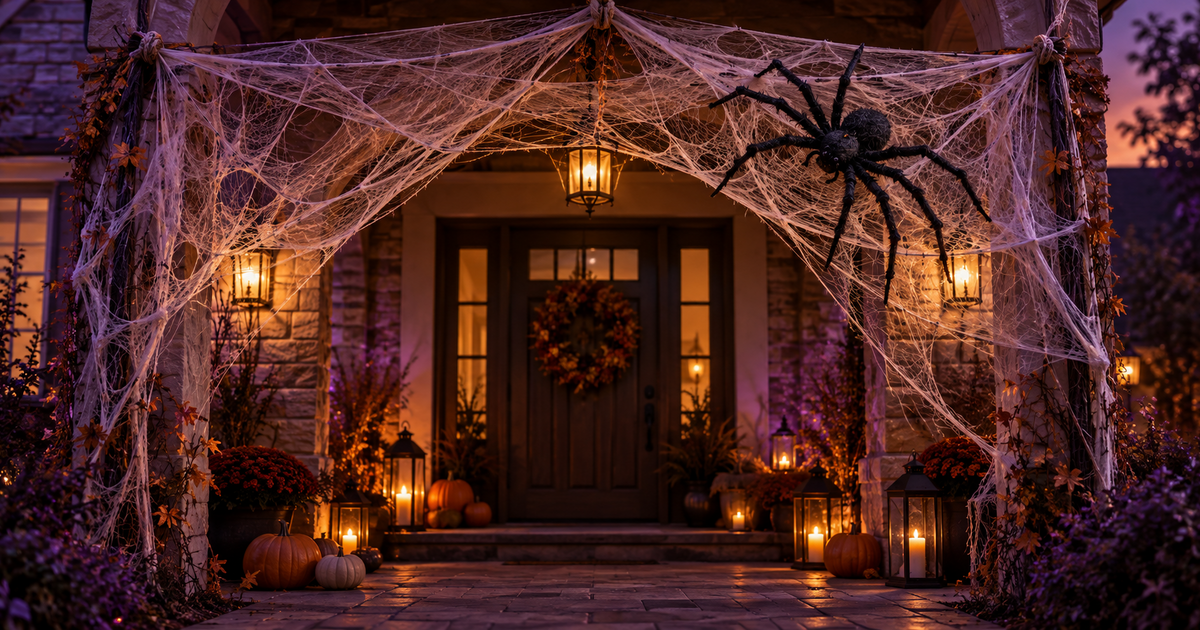
How to Make Realistic Spider Webs for Halloween: Stretch Web, Rope Web, and Safer DIY Techniques
Realistic Halloween spider webs come from stretching synthetic cobweb material thin over a frame of rope, branches, or fishing line rather than piling it on thick, then adding depth with a few oversized spiders and, if you want extra texture, a light dusting of baby powder or fine glitter. Skip the thick, glow-white “bag of cobweb” look by pulling the fibers apart slowly and anchoring them at multiple points instead of one clump.
Haunt Harvester is reader-supported and may earn a commission from qualifying purchases made through links on this page, at no extra cost to you. We only feature products we would tell a friend about.
Most yards that go overboard on spider webs end up looking like a costume shop exploded rather than something a spider actually built. The fix is not more web — it is thinner web, pulled tighter, anchored at more points, and layered with a couple of well-placed spiders instead of one giant clump. If you want to see the full range of web styles and spider props available, you can browse our Halloween decor picks on Amazon, then use the techniques below to make them look real.
What materials make the most realistic spider webs?
| Material | Best use | Realism level |
|---|---|---|
| Stretch cobweb (synthetic fiber bag) | Bushes, porch railings, doorways — pulled thin, not clumped | High, if stretched thin |
| Rope or twine web | A single large “feature” web on a wall, gate, or archway | Very high — reads as an actual web shape |
| Cheesecloth or gauze | Draping over furniture, statues, or a dead-tree scene for an aged, torn look | High for texture, not literal web shape |
| Fishing line | Invisible “trip line” strands between props for a floating-thread effect | High — nearly invisible in daylight, catches porch light at night |
Most home haunters get the best results mixing two of these: a rope or fishing-line web for the main shape, then a thin layer of stretch cobweb material pulled across it for texture.
How do you build a realistic rope or twine spider web?
- Pick your anchor points. A real web needs at least five or six anchor points — a porch post, a gate, a tree branch, a fence rail — not just two corners.
- Run the “spokes” first. Tie rope or heavy twine from a center point out to each anchor, like spokes on a wheel, leaving them slightly loose rather than taut.
- Add the spiral. Starting near the center, wind a second, thinner cord around the spokes in a loose spiral, tying it off at each spoke as you go so it holds its shape.
- Vary the spacing. Real webs are not perfectly even — tighter spiral near the center, wider gaps toward the edges reads as far more convincing than a uniform grid.
- Weatherproof it. Use outdoor-rated rope or twine if the web will be up for more than a night or two, since regular cotton twine sags and frays fast in rain or dew.
How do you stretch cobweb material so it looks real?
Pull, don’t pile
Straight out of the bag, stretch cobweb is a dense clump. Grab a small handful and pull it slowly and evenly in multiple directions until it turns thin and stringy — you should be able to see through it in most spots. A little goes much further stretched thin than it does piled on thick.
Anchor at more than two points
Drape thin sections between three or more points — a bush branch, a porch rail, a doorframe corner — rather than stretching one piece corner to corner. Real webs branch and connect in multiple directions, and your material should too.
Add depth with spiders and debris
A few oversized spider props anchored at different depths in the web, plus a scattering of small dark “bugs” caught in a few strands, sells the illusion far more than adding more web material ever will.
Fire and wildlife safety: stretch cobweb material is made from lightweight synthetic fiber and is highly flammable — decorations are the first item ignited in hundreds of home fires every Halloween season, most often because they sat too close to a candle, light bulb, or other heat source. Keep any stretch web well away from jack-o’-lanterns, string lights, and porch fixtures that get warm. It is also a real hazard to birds and small animals, which can become tangled in the dense fibers, especially overnight — take webbing down promptly after Halloween, and consider keeping dense stretch web to covered porches and indoor displays rather than open yard trees and bushes where wildlife is more likely to encounter it.
What are safer alternatives to stretch cobweb?
- Rope or twine webs — reusable year after year, not flammable in the way loose synthetic fiber is, and safe around wildlife once taken down.
- Paper webs — cut or folded paper webs work well for indoor windows and are easy to store flat.
- Light-up string webs — pre-made webs built around string lights give you the glow without a dense fiber hazard.
- Fishing line “trip strands” — a handful of taut fishing-line strands catches porch light at night for an eerie effect with almost no material at all.
For a full build that puts web, gate, and lighting together, see our gothic cemetery gate guide, and if you are furnishing a whole yard from scratch, start with our first home haunt beginner’s guide.
Frequently Asked Questions
How do I make cheap cotton cobwebs look less fake? Stretch the material as thin as it will go before hanging it, anchor it at three or more points instead of two, and add one or two spiders at different depths rather than draping it flat.
Is stretch spider web safe to use outside? It can be, but keep it well clear of any heat source — candles, string lights, porch fixtures — since the fiber is highly flammable, and take it down promptly so birds and small animals do not get tangled in it overnight.
How do I make a spider web without buying cobweb material? Rope, twine, or even yarn tied in a spoke-and-spiral pattern between several anchor points makes a very convincing web and can be reused every year.
How much stretch web do I need for a porch? Less than you think — a single bag stretched thin and spread across several anchor points usually covers a porch better than two or three bags piled on thick.
Do fake spider webs attract real spiders? Not meaningfully. Real spiders build their own webs and generally ignore synthetic decorations; any overlap is coincidental rather than the material attracting them.
Want the rest of the scene to match? Plan your full home haunt build.

As an Amazon Associate we may earn commission from qualifying purchases at no extra cost to you.
new in halloween animatronics
Our honest Spirit Halloween Whirling Wendy review: a 360-degree counter-spinning clown we score 3.7/5. See if this photogenic 2026 centerpiece is worth it.
Spirit Halloween's Willow Witch is a 5 ft 9 in 2026 animatronic at $299.99 with industry-first conversation-response tech that listens and replies in real time.
Home Depot's 8 ft Perilous Plant Monster animatronic (2026) is a $299 outdoor Wicked Woods giant. See what it does, where to buy it, and if it is worth it.
Find Haunted Houses in:
trending in haunt industry
Everything you need to know about East Coast Haunters Convention 2026 — dates, location, what to expect, haunt tours, seminars, and how to get tickets before prices increase.
HalloweenCostumes.com's 2026 Fan Design Program lets you design a real Halloween animatronic. Two winners get 10 props each plus 5% revenue. Submissions close April 30.
ShudderCon 2026 runs April 25–26 at Camp Jordan Arena in East Ridge, TN. Tickets from $15–$75. Here's the full preview for horror fans, haunt pros, and scare actors.