

How to Build a DIY Air Cannon Jump-Scare Prop for Halloween
A DIY air cannon jump-scare prop uses a small air compressor or tank, a 12V sprinkler-style solenoid valve, and a short air line to release a burst of stored air that pops a lightweight prop into a guest’s path in a fraction of a second, triggered by a hidden remote, a PIR motion sensor, or a pressure mat. Most home-haunt builds run 40–80 PSI — nowhere near the pressure of an industrial air cannon — and the real safety rule is simple: aim the prop’s motion alongside or away from guests, never at them.
Haunt Harvester is reader-supported and may earn a commission from qualifying purchases made through links on this page, at no extra cost to you. We only feature products we would tell a friend about.
The classic jump-scare pop — a coffin lid that snaps open, a figure that lurches up from behind a barrel, a sign that flips into a guest’s face — almost always comes down to compressed air, not a motor. A motor has to accelerate; a solenoid valve dumping stored air into a cylinder or bellows fires in well under a tenth of a second, which is what makes the scare feel instant instead of telegraphed. If you want to see the electronics and prop-building hardware home haunters reach for on builds like this, you can browse our Halloween prop-building picks on Amazon, though most of the specialty air parts below come from a hardware or irrigation-supply aisle rather than a costume shop.
What makes a pneumatic trigger different from a motor or a motion sensor?
A motion sensor plug is just an on/off switch — great for lights, fog machines, or anything that does not need to move fast. A motor-driven prop (most Spirit Halloween and Home Depot animatronics) moves at motor speed, which reads as animation, not a scare. Compressed air is the cheap, DIY-friendly way to get near-instant motion: the valve opens, stored pressure releases in a burst, and the prop pops before a guest’s eye can track it. That speed is also why pneumatic props need more safety margin than a motor-driven one — there is real, if modest, force behind the motion.
What parts do you need to build a basic air cannon prop?
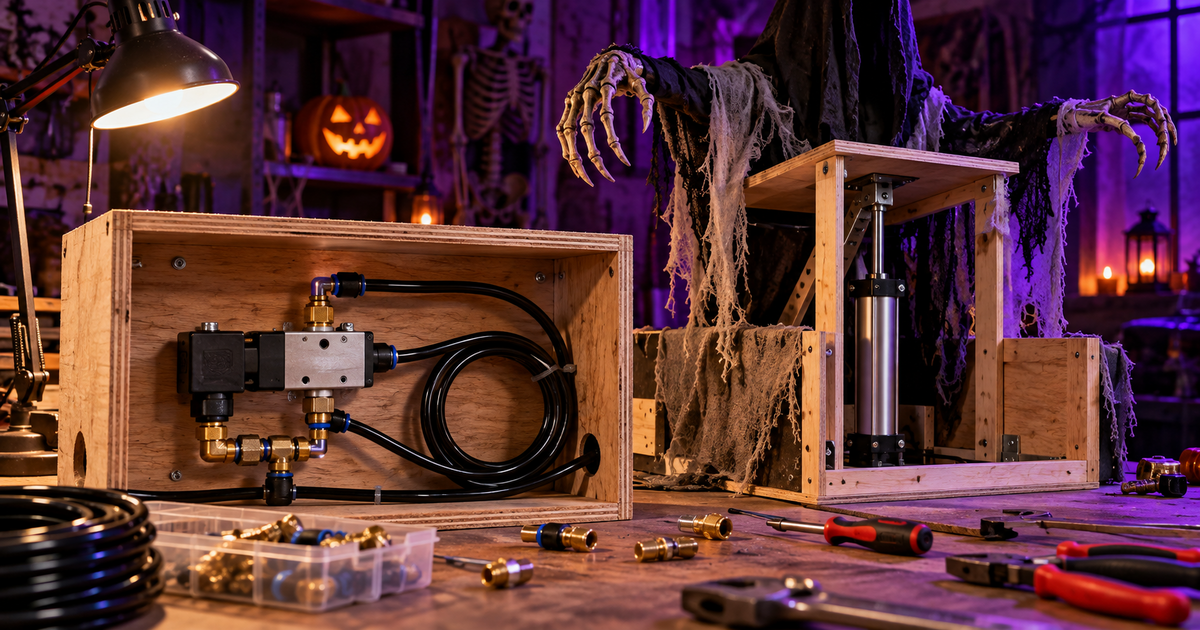
A basic build has four parts: something to store air (a small pancake-style air compressor, 2–6 gallons, is enough for most props), a 12V sprinkler-style solenoid valve to release it on command, 1/4-inch push-to-connect air line and fittings to route it, and a relay or prop controller to switch the valve from whatever trigger you choose. From there, the air pushes a piston, a bellows, or a simple hinged flap to pop your prop into motion.
| Part | What it does | Typical price |
|---|---|---|
| 12V solenoid valve | Opens electronically to release stored air in a fraction of a second — the part that actually makes the “pop” | $10–$25 |
| Small pancake air compressor | Stores and supplies the compressed air; a 2–6 gallon tank is enough for most single-prop builds | $60–$120 |
| Push-to-connect air line & fittings | Routes air from tank to valve to the prop’s cylinder or bellows | $10–$20 |
| Relay module or prop controller | Switches the valve on from a PIR sensor, pressure mat, or hidden remote | $10–$30 |
How much air pressure does a Halloween prop actually need?
Far less than most people assume. Home-haunt pneumatic props typically run at 40–80 PSI, which is enough to snap a lightweight lid or push a bellows-driven prop with real speed — you are not building an industrial air cannon, and higher pressure just adds risk without adding scare. A basic shop compressor with a regulator and gauge lets you dial in and hold a safe, consistent pressure instead of guessing.
How do you wire and trigger it?
- Build or buy the moving part first. A simple hinged flap, a piston pushing a lightweight prop, or a small bellows under a fabric-covered frame all work — keep the moving mass light so a burst of air can move it fast.
- Plumb the air line from tank to valve to prop. Push-to-connect fittings make this a no-tools job; keep the run as short as practical so less pressure is lost before it reaches the prop.
- Wire the solenoid valve to a relay, and the relay to your trigger of choice — a PIR motion sensor for a fully automatic scare, a hidden pressure mat for guests to step on, or a handheld remote if you want to time the pop yourself from a hidden spot.
- Set the regulator to 40–80 PSI and test with the prop aimed at open space or a wall, not at a person, until you know exactly how it moves.
- Add the reset. Most simple builds are gravity-reset (the prop just falls back down) or spring-loaded; either way, confirm it resets fully between triggers before you open for guests.
Safety first, every time: never aim a pneumatic prop’s motion at a person — aim it up, to the side, or into open space so the moving part cannot reach a guest even if it releases early. Always run a pressure regulator between the compressor and the valve so the prop cannot over-pressurize, keep the tank, valve, and wiring enclosed or behind a barrier guests cannot reach, and test extensively at your lowest working pressure before dialing it up. If wiring 12V electronics and working with compressed air is outside your comfort zone, a simpler lighting or motion-triggered build gets you most of the scare with a lot less risk.
Do you need an air compressor, or is there a simpler version?
An air compressor is the most reliable air source because it refills itself, but it is not the only option. Some home haunters use a hand-pumped or CO2-charged tank for a single, low-volume prop instead — fewer pops before a refill, but no compressor cost. If a compressed-air build still sounds like more than you want to take on, a motion-triggered light or sound cue timed to a static prop gets a real reaction with no pneumatics at all, and pairs well with the layout planning you are already doing for the rest of your haunt.
Frequently Asked Questions
Is a DIY air cannon prop safe for a home haunt? Yes, if you follow the core rule: aim the prop’s motion away from guests, use a pressure regulator, and keep the compressor, valve, and wiring enclosed behind a barrier. The risk is not the air pressure itself — 40–80 PSI is modest — it is an unshielded moving part in a guest’s path.
How much air pressure does a Halloween prop actually need? Most home-haunt pneumatic props run 40–80 PSI. That is enough force to snap a lightweight lid or bellows quickly; you do not need anywhere close to what an industrial air cannon runs.
Can I trigger it with a motion sensor instead of a remote? Yes — wire a PIR motion sensor to the relay that switches the solenoid valve and the prop fires automatically when a guest crosses its field of view, the same logic used for motion-triggered lights and fog machines.
Do I need an air compressor, or can I use a CO2 tank? A small compressor is the most reliable option because it refills itself between scares. A hand-pumped or CO2-charged tank works for a single low-volume prop but gives you fewer pops before you need to recharge it.
What is the easiest first pneumatic prop to build? A simple hinged flap or lid pushed open by a piston is the most beginner-friendly version — fewer moving parts than a full pop-up figure, and it is easy to test at low pressure before you commit to a bigger build.
Ready to plan where this scare fits in your layout? Start with our home haunt beginner’s guide.

As an Amazon Associate we may earn commission from qualifying purchases at no extra cost to you.
new in halloween animatronics
Our honest Spirit Halloween 6 Ft 11 In Lady Misfortune review: a near-7-foot color-changing witch with a crystal ball for $109.99. We score it 3.4 of 5.
Our honest Spirit Halloween 9 Ft 5 In Sinister Straw Man review: a $385.99 giant that springs up to 9 feet with glowing eyes. We score it 3.6 out of 5.
Our honest Spirit Halloween 3 Ft Bog Monster review: a $325.99 outdoor swamp creature that lunges on a sensor. We score this animatronic 3.8 out of 5.
Find Haunted Houses in:
trending in haunt industry
Everything you need to know about East Coast Haunters Convention 2026 — dates, location, what to expect, haunt tours, seminars, and how to get tickets before prices increase.
HalloweenCostumes.com's 2026 Fan Design Program lets you design a real Halloween animatronic. Two winners get 10 props each plus 5% revenue. Submissions close April 30.
ShudderCon 2026 runs April 25–26 at Camp Jordan Arena in East Ridge, TN. Tickets from $15–$75. Here's the full preview for horror fans, haunt pros, and scare actors.