

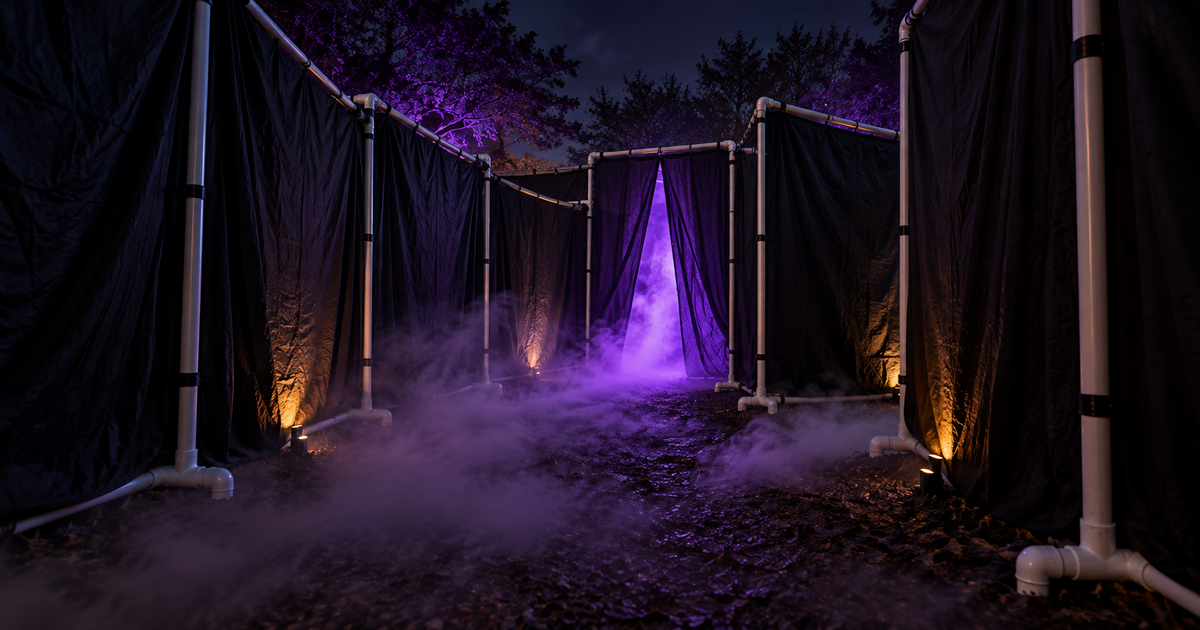
How to Build DIY Haunted House Maze Walls with PVC Pipe and Black Fabric
Portable haunted house walls can be made from PVC pipe cut into 7 to 8 foot uprights and 4 to 5 foot rails, joined into rectangles, weighted at the base and covered with black fabric or plastic. Hang black fabric dividers from the top rails to make rooms, cut a flap in each so visitors can pass, and leave 35 to 40 inches of path width.
If you are building a walk-through haunt in a garage or backyard, walls are the biggest cost, and PVC frames are the cheapest to cut, move and store. Start with PVC pipe and connectors, add black plastic sheeting or fabric, and plan your route before you buy anything. Our home haunt layout guide is a good companion for the floor plan.
What do you need for DIY haunted house walls?
| Item | Used for | Budget swap (CubeSmart) |
|---|---|---|
| PVC pipe and connectors | Wall frames | Free or cheap PVC from online marketplaces |
| Wood panels or pallets | Base and reinforcement | Large appliance boxes or free pallets |
| Blackout fabric or black plastic sheets | Wall covering, ceiling, dividers | Black trash bags cut open at the seams |
| Sandbags or heavy weights | Anchoring | Cinder blocks or water jugs |
| Duct tape and zip ties | Fastening | Twine or cloth strips |
| Floor tarps or drop cloths | Covering the floor | Old blankets, sheets or tablecloths |
Covers and All, a cover seller whose post is promotional, makes the same point about black plastic sheets or heavy garbage bags: cheaper, and good at resisting rain. It also found 1100 square feet of spider web material for $13 on Amazon, a price we have not verified.
How do you build the walls?
These steps follow the wall construction recipe in CubeSmart’s “How to Make a Haunted House.”
- Cut the frame. Cut PVC to 7 to 8 feet for the vertical pieces and 4 to 5 feet for the top and bottom rails, then join them with connectors into a rectangle for each wall.
- Set the base. Lay wood panels or pallets on the ground and attach each wall’s bottom rail with zip ties, duct tape or twine.
- Reinforce. Tape a wood panel, cardboard sheet or pallet to each wall.
- Anchor. Weigh down the base and walls with sandbags or cinder blocks.
- Add the ceiling. Drape black fabric or plastic over the frame and fasten it.
- Cover the walls. Cover the inside and outside of each wall with black fabric.
- Hang dividers. Hang black fabric between rooms from the top rails near the ceiling, and cut a flap in each sheet so visitors can pass through.
- Finish doors and floor. Install a wood panel or curtain at the entrance and exit, and cover the base with drop cloths or tarps held down with weights.
How should you lay out the maze?
- Sketch the flow first. CubeSmart suggests entrance, tunnel, two to three rooms and exit, with the tunnel placed between the entrance and first room.
- Mark it on the ground. Outline the path with chalk or tape, and mark where entries, rooms and exits go.
- Leave room. CubeSmart recommends 35 to 40 inches of space so the path fits foot traffic and mobility devices.
- Decide rooms or maze. Covers and All says to draw a simple map and choose between rooms and a maze, and to plan hidden compartments for jump scares.
- Budget extra. Covers and All suggests adding 50% to your estimate and spending the most on your biggest scares.
Once the walls stand, add a lighting plan, and use our budget haunt guide to decide where money goes. Covers and All’s own scare suggestion is an animatronic clown at the entrance with a live actor who lunges at guests inside.
How do you keep a walk-through haunt safe?
CubeSmart gives these power and safety steps for the build:
- Run extension cords along the top or bottom edges of the structure, never across footpaths, and secure them with electrical tape.
- Plug equipment into GFCI-protected outlets when possible.
- Avoid daisy-chaining or overloading power strips, and keep them away from fabric and other flammable materials.
- Anchor the base and walls so the structure stays stable.
- Cut exit flaps in tunnel sheets so guests who feel overwhelmed can leave.
- Walk through the whole haunt at night before opening to check the path, lighting, effects and hazards.
Our addition: neither source covers fire safety for fabric walls. Use flame-resistant fabric where you can find it, keep heaters and bulbs well clear of drapes, and check local rules before you invite the public in. See our guide to outdoor cord and power safety, and a heavy-duty cord such as this outdoor extension cord suits the job.
Frequently Asked Questions
What is the cheapest way to make haunted house walls? PVC frames covered with black plastic or fabric. CubeSmart also suggests free pallets, appliance boxes and cut-open black trash bags.
How tall should the walls be? CubeSmart cuts the uprights to 7 to 8 feet and the top and bottom rails to 4 to 5 feet.
How wide should the path be? CubeSmart recommends 35 to 40 inches so the route works for foot traffic and mobility devices.
How do you stop the walls from falling over? Attach them to a wood or pallet base and weigh the base down with sandbags, cinder blocks or water jugs.
How do you hang dividers between rooms? Hang black fabric from the top PVC rails and cut a flap in each sheet so visitors can walk through.
Ready to plan your route? Map your home haunt first.

As an Amazon Associate we may earn commission from qualifying purchases at no extra cost to you.
new in halloween animatronics
When is the best time to buy Halloween animatronics? Compare preseason launches, late-October markdowns, post-Halloween clearance and off-season buying to save.
Lowe's cut 9 Haunted Living and Disney animatronics 30-55%. See which markdowns are the best value per foot, which to skip, and how to check price and stock.
Our honest Spirit Halloween Mr. Dark review: a black-robed skeleton that pops up to nearly nine feet on a scissor lift for $370.99. We score it 3.9 of 5.
Find Haunted Houses in:
trending in haunt industry
Everything you need to know about East Coast Haunters Convention 2026 — dates, location, what to expect, haunt tours, seminars, and how to get tickets before prices increase.
HalloweenCostumes.com's 2026 Fan Design Program lets you design a real Halloween animatronic. Two winners get 10 props each plus 5% revenue. Submissions close April 30.
ShudderCon 2026 runs April 25–26 at Camp Jordan Arena in East Ridge, TN. Tickets from $15–$75. Here's the full preview for horror fans, haunt pros, and scare actors.