

How to Build a Haunted Forest Scene for Halloween: Trees, Fog, and Lurking Creatures
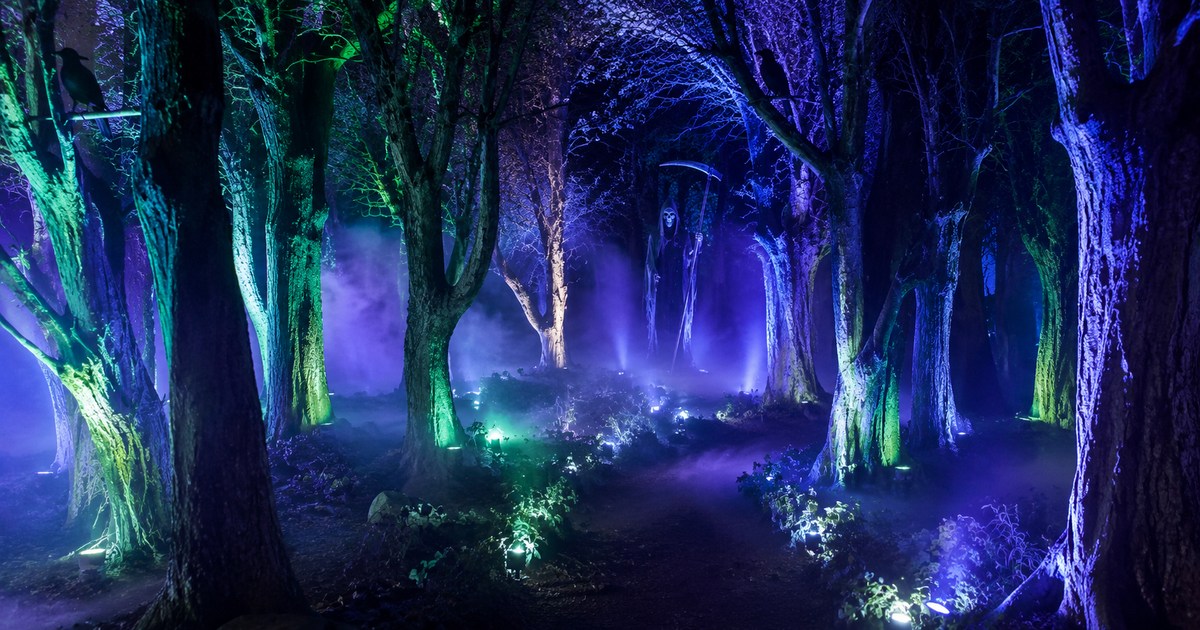
To build a haunted forest scene, start with the trees and work in layers. Frame the space with bare, gnarled branches or black silhouette trees, roll low fog across the ground, and wash the trunks in green and blue uplighting so the shadows climb upward. Then add depth with hanging ghosts, perched ravens, a lurking creature at the tree line, and a hidden speaker playing wind and distant howls. The goal is a wood you would not want to walk through alone.
A haunted forest is one of the most flexible scenes a home haunter can build, because nature does half the work. You are not recreating a specific monster or movie — you are staging a place, and a dark wood is already unsettling before you add a single prop. That makes it forgiving for beginners and endlessly layerable for veterans. If this is your first big build, our complete beginner’s guide to setting up a home haunt covers the fundamentals this scene builds on.
What makes a forest scene feel haunted instead of just dark?
The effect comes from a familiar place turned wrong. A real forest is calm, green, and full of life; a haunted one keeps the shape of a wood but drains the safety out of it. Bare branches instead of full leaves read as dead. Fog you cannot see through reads as hidden danger. Cold, colored light where you expect warm sun tells your eye that something is off. Aim for “this forest is watching you” rather than a pile of generic Halloween props, and the atmosphere does the psychological work.
| Layer | What it does | Starting point |
|---|---|---|
| Trees and branches | Builds the setting and blocks sightlines | Bare branches, black silhouette trees, moss |
| Fog | Hides the ground and adds depth | A fog machine at ground level |
| Lighting | Turns a wood into a nightmare | Green and blue uplighting, one cold spot |
| Creatures | The threat lurking in the trees | One animatronic anchor, ravens, ghosts |
| Sound | Fills the dark you cannot light | Hidden speaker: wind, howls, whispers |
How do you build the forest itself?
Establish the woods before you add the scares. The backbone of the scene is vertical structure: bare, gnarled branches, tall black tree silhouettes cut from plywood, or real limbs zip-tied to stakes and fence posts. Cluster them so visitors cannot see cleanly through the yard — a haunted forest works because you never quite know what is behind the next trunk. Drape gauze, cheesecloth, and moss over the branches to add texture and soften hard edges into something older and overgrown.
Then define a path. A narrow, winding route through the trees is far scarier than an open lawn, because it forces people close to whatever you hide alongside it. If you are laying out a walk-through or a larger yard, our guide to planning your home haunt layout from scratch covers the sightlines and traffic flow that keep a forest path from turning into clutter.
How should you light a haunted forest?
Lighting is what separates a spooky garden from a genuine dark wood. Skip flat white floodlight and go cold, colored, and directional.
- Uplight the trunks. Hide small spotlights low at the base of trees and angle them up so shadows climb the bark — the fastest way to make ordinary branches loom.
- Use cold colors. Deep green and blue read as moonless woods; a single sickly amber or red accent suggests something unnatural deeper in the trees.
- Backlight your silhouettes. A light behind a creature or a figure at the tree line turns it into a black shape against the fog, which the imagination fills in far better than any detailed prop.
- Leave real darkness. Resist lighting everything. Pools of black between the trees are where the fear lives; light the path and the anchors, and let the rest stay unknown.
What creatures belong in the trees?
Restraint reads as menace. A forest crammed with every prop you own looks like a yard sale; a few well-placed inhabitants with room to breathe look like a threat. Give the scene one anchor — a tall reaper, a witch, or a lurking creature set back in the trees where the fog is thickest — and let it be the star. A single animatronic that leans, turns, or reaches as visitors pass is worth a dozen static props. Our roundup of Halloween animatronics guides helps you pick a centerpiece, and a tall figure like the Screaming Reaper makes a natural tree-line lurker.
Fill the canopy with cheaper detail: ravens and crows perched on branches, bats overhead, and hanging ghosts drifting between the trunks. A DIY chicken-wire ghost glowing softly among the trees costs almost nothing and reads beautifully through fog. Whatever you add, leave negative space — an empty, fog-filled gap where something might be standing is scarier than a crowded one.
How do fog and sound tighten the scene?
Fog and audio are what turn a set of props into a place. A low layer of fog hides the ground, blurs the bases of your trees, and lets a creature seem to materialize out of nowhere; drifting a beam of colored light through it doubles the effect. For that classic ground-hugging look, start with our guide to the best fog machines for Halloween and home haunts, and if you want the fog to sit low among the trunks rather than float away, our home-haunt fog effect guide walks through chilling it.
Sound seals it. A hidden speaker playing wind through branches, distant howls, snapping twigs, or a low whisper tells visitors the forest is alive before they see anything move. Keep the volume low and the source hidden so it seems to come from the dark, not from a speaker on the porch. As always, keep audio at neighborly levels and fog off the sidewalk and street.
Build the scene: gear for a haunted forest
Much of a forest is branches and fabric you can gather or thrift, but a few pieces of gear carry the scene at night. Roughly highest impact first.
Haunt Harvester is reader-supported and may earn a commission from qualifying purchases made through links on this page, at no extra cost to you. We only feature products we would tell a friend about.
- Fog machine — rolls low fog between the trunks and lets creatures appear out of nowhere.
- Colored outdoor spotlights — green and blue uplighting is what turns bare branches into a looming dark wood.
- Black decorative branches and trees — the vertical bones of the scene; cluster them to block clean sightlines.
- Reaper or creature animatronic — one tall figure set back in the fog anchors the tree line as the focal scare.
- Raven and crow props — perch them on branches and posts to fill the canopy with cheap, eerie detail.
- Outdoor speaker — hide it to play wind, distant howls, and whispers from somewhere in the trees.
- Heavy-duty outdoor extension cord — power lights, fog, and figures safely from a GFCI outlet without thin daisy-chains.
Frequently Asked Questions
How do I make my yard look like a forest? Build vertical structure first: cluster bare branches, black silhouette trees, or real limbs on stakes so they block clean sightlines, then drape moss and gauze for age. Add fog, cold uplighting, and a winding path, and an ordinary lawn reads as dense woods.
What colors of light work best for a haunted forest? Cold green and blue read as a moonless wood. Uplight the trunks so shadows climb, backlight your creatures into silhouettes, and add one sickly amber or red accent deeper in the trees. Avoid flat white floodlight, which flattens the whole scene.
What props go in a haunted forest scene? One animatronic anchor — a reaper, witch, or lurking creature — set back in the fog, plus cheaper detail in the canopy: ravens, crows, bats, and hanging ghosts. Leave gaps; empty fog is scarier than clutter.
How do I get low fog to stay among the trees? A standard fog machine drifts fog that rises and floats off. To keep it hugging the ground between trunks, chill the output or use a fog chiller as covered in our home-haunt fog guide, and run it in short bursts so the layer rebuilds.
Can I build a forest scene on a budget? Yes. Gathered branches, thrifted fabric, moss, and a DIY ghost get you most of the way; add a fog machine, colored lights, and one animatronic as the budget allows. It scales the same way any yard haunt does.
Ready to pick the creature that lurks in your trees? Browse our Halloween animatronics guides to choose the centerpiece for your haunted forest.

As an Amazon Associate we may earn commission from qualifying purchases at no extra cost to you.
new in halloween animatronics
Our honest Spirit Halloween Whirling Wendy review: a 360-degree counter-spinning clown we score 3.7/5. See if this photogenic 2026 centerpiece is worth it.
Spirit Halloween's Willow Witch is a 5 ft 9 in 2026 animatronic at $299.99 with industry-first conversation-response tech that listens and replies in real time.
Home Depot's 8 ft Perilous Plant Monster animatronic (2026) is a $299 outdoor Wicked Woods giant. See what it does, where to buy it, and if it is worth it.
Find Haunted Houses in:
trending in haunt industry
Everything you need to know about East Coast Haunters Convention 2026 — dates, location, what to expect, haunt tours, seminars, and how to get tickets before prices increase.
HalloweenCostumes.com's 2026 Fan Design Program lets you design a real Halloween animatronic. Two winners get 10 props each plus 5% revenue. Submissions close April 30.
ShudderCon 2026 runs April 25–26 at Camp Jordan Arena in East Ridge, TN. Tickets from $15–$75. Here's the full preview for horror fans, haunt pros, and scare actors.